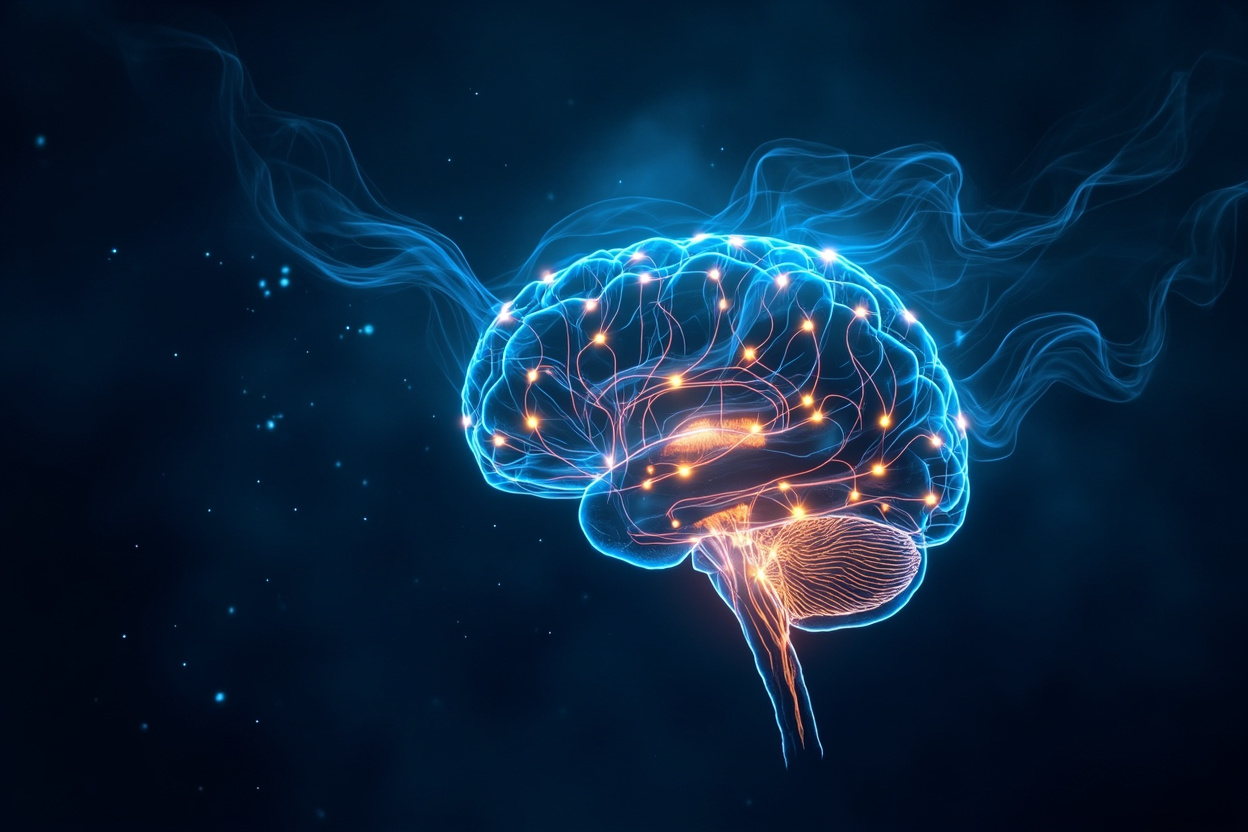
That moment when sandalwood fills your meditation space and suddenly your breathing slows. Not imagination. Your brain just released actual chemicals in response to actual molecules entering your nasal passages. Modern neuroscience now explains what ancient practitioners knew for thousands of years.
The Olfactory Shortcut to Your Limbic System
Smell travels a unique neural pathway. Unlike sight or sound, scent signals bypass the thalamus and go directly to the limbic system—the brain’s emotional processing center. This ancient route connects directly to the amygdala (emotional memory) and hippocampus (memory formation).
When you burn incense, aromatic compounds travel through your nostrils to olfactory receptors. These receptors translate chemical signals into electrical ones, sending them directly to your brain’s most primitive structures. This explains why a particular scent can instantly trigger a vivid memory from decades ago.
The Xiangdao Xinbian (香道新编, New Compilation of Incense Way) notes: “The nose receives what the heart desires. Fragrance enters without passing through gates, reaching the spirit before thought begins.” Modern science confirms this poetic wisdom.
How Different Incense Compounds Affect Neurotransmitters
Sandalwood: Activating Calm Receptors
Sandalwood contains santalol, a compound that binds to serotonin receptors in the brain. Specifically, it activates 5-HT1A receptors associated with anxiety reduction and relaxation. Research published in the Journal of Neuroscience shows that santalol increases GABA activity—the the same neurotransmitter targeted by anti-anxiety medications.
When you burn sandalwood, you are not creating ambiance. You are initiating a measurable neurochemical cascade that reduces neuronal excitability throughout your nervous system.
Frankincense: The Boswellia Effect
Frankincense resin contains incensole acetate, a compound that specifically targets the TRPV3 ion channel in the brain. This channel is involved in thermal perception and emotional regulation. Studies show incensole acetate reduces anxiety through a mechanism distinct from benzodiazepines—no sedation, no dependency, just calm.
Ancient temple priests burning frankincense were not performing symbolism. They were administering a precise psychoactive compound through the most efficient delivery method available: inhalation directly to the brain.
Lavender: GABA Modulation
Lavender’s linalool binds to GABA-A receptors, enhancing the calming effect of this inhibitory neurotransmitter. Unlike pharmaceutical GABA supplements (which cannot cross the blood-brain barrier when taken orally), inhaled lavender delivers linalool directly via the olfactory route.
A 2016 study in Frontiers in Behavioral Neuroscience demonstrated that lavender exposure increased alpha wave activity in the brain—associated with relaxed alertness and creative states—within 40 minutes of exposure.
The Entourage Effect in Incense Burning
Natural incense contains dozens to hundreds of aromatic compounds that work together. This “entourage effect” means the therapeutic impact of burning whole natural incense exceeds the sum of individual isolated compounds.
When frankincense and myrrh burn together, their respective compounds show synergistic anti-inflammatory effects in brain tissue. This explains why traditional incense formulas from China, India, and the Middle East consistently used compound blends rather than single ingredients.
The Ming Dynasty incense texts specified precise ratios for palace formulas, noting that “single wood creates single effect; combined woods create harmony of spirits.” Modern pharmacology validates this empirical wisdom.
Practical Applications for Mental States
For Anxiety Reduction
Use sandalwood or frankincense. Light the stick, let smoke circulate for 2-3 minutes, then sit at least three feet away. Inhale naturally through your nose. Within 15-20 minutes, cortisol levels measurably decrease and heart rate variability improves.
For Focus and Concentration
Cedarwood or rosemary work through different mechanisms. Cedarwood contains cedrol, which increases acetylcholine—a neurotransmitter essential for attention and memory. Rosemary’s 1,8-cineole improves cognitive processing speed and working memory retention.
For Sleep Preparation
Lavender remains the evidence-based choice for sleep induction. Burn for 30 minutes before bedtime, then let the residue continue releasing aromatic molecules through the night. Studies show this pre-sleep lavender exposure increases deep sleep duration by up to 20%.
Why Incense Works Better Than Air Fresheners
Air fresheners mask odors with synthetic fragrance molecules that do not bind to olfactory receptors in meaningful ways. They create perceived freshness without any neurochemical effect.
Incense delivers bioactive compounds that actually bind to brain receptors. When you burn sandalwood, you are inhaling therapeutic molecules that trigger measurable neurological responses. An air freshener cannot do this because its molecules are designed for olfactory masking, not receptor binding.
The Dose and Duration Matter
Neurochemical effects depend on concentration and exposure time. A brief 5-minute burn in a large room produces minimal effect. A 20-30 minute burn in a small space with good airflow produces therapeutic concentrations.
For daily meditation practice, burn incense for the entire session. For sleep, burn 30 minutes before and let residual aroma continue. For acute anxiety, even 10-15 minutes of frankincense exposure produces measurable calming effects.
Frequently Asked Questions
Can incense actually reduce anxiety or is it just placebo?
Multiple peer-reviewed studies confirm physiological anxiety reduction from incense compounds, independent of placebo effect. Frankincense’s incensole acetate reduces anxiety markers in both animal models and human trials. Sandalwood’s santalol increases GABA activity measurable by EEG. These are not subjective reports—they are documented neurochemical changes.
How long does it take to feel the effects?
Initial effects begin within 5-10 minutes of exposure as aromatic compounds reach brain receptors. Peak effect typically occurs 20-30 minutes into exposure. For sleep applications, effects continue throughout the night as low-level aromatic exposure persists from residue.
Is burning incense safe for daily use?
Natural incense from trusted sources is safe for daily use. Ensure adequate ventilation—burn in spaces with airflow, not sealed rooms. Limit exposure to 30-60 minutes per session. Avoid synthetic “incense” that contains accelerants and artificial fragrances, which produce harmful combustion byproducts.
Related Articles
- Meditation Incense: A Complete Guide to Mindfulness Practice
- Incense for Sleep: Natural Remedies for Better Rest
- What is Hexiang (合香): Ancient Chinese Compound Incense
Try It Tonight
Tonight, before bed, burn 15 minutes of lavender incense in your bedroom with a window cracked open. Notice how your breathing changes within minutes. Notice how your mental chatter quiets. This is not relaxation technique. This is chemistry happening in real time inside your brain.
Ancient practitioners did not need microscopes or EEG machines. They learned through millennia of careful observation. Modern neuroscience now confirms what they discovered through direct experience: certain scents create specific mental states by triggering specific neurochemical releases.