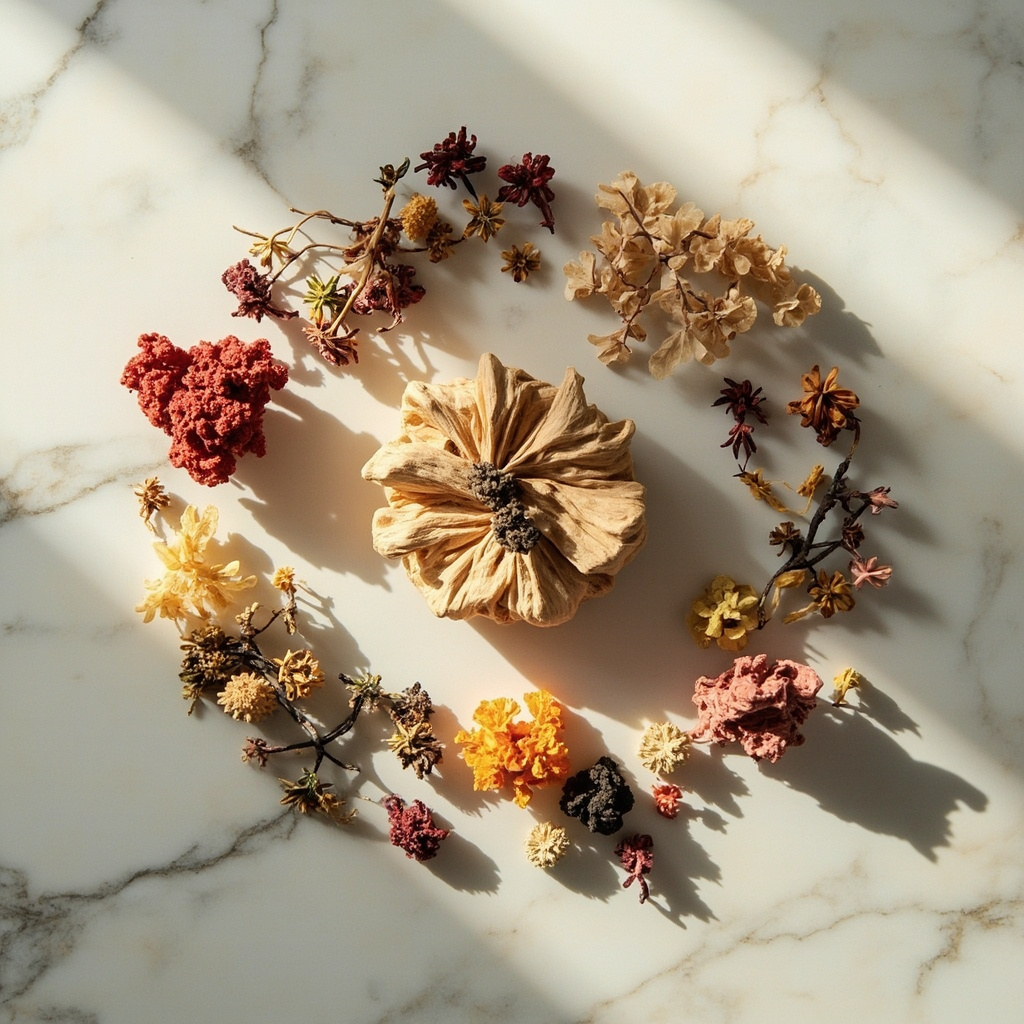
On the cliffsides and forest margins of Yunnan province, where the air stays humid even through the dry season and the soil carries the mineral richness of ancient limestone, grows one of the most beautiful and elusive orchids in China—Wu Mei Lian, the blackbone orchid. The plant’s common name—blackbone—refers to the dark purplish-black stems that give the orchid its distinctive appearance, while the beautiful flowers—white or pale pink with intricate lip markings—have made it a prized ornamental as well as a source of aromatic material.
The genus Dendrobium includes dozens of species throughout Asia, but Wu Mei Lian (Dendrobium candidum in classical texts, though modern taxonomy has reclassified many species) has pride of place in the Chinese materia medica as “the premier among orchids”—a category of herbs known for their ability to “nourish yin, generate fluids, and clear heat.” Where most tonic herbs either supplement qi or blood, orchids like Wu Mei Lian work on the yin aspect of the body—the cooling, nourishing, lubricating dimension that underlies all healthy function.
What Is Wu Mei Lian
Wu Mei Lian refers to several Dendrobium species used medicinally, with Dendrobium officinale (previously classified as Dendrobium candidum) considered the premier species. The entire plant is used—the stems (called “tiepi shihu” or iron-skin dendrobium in commerce) and sometimes the flowers.
The distinguishing characteristics include:
- The dark purplish-black stem color that gives the “blackbone” name
- The white or pale pink flowers with distinctive lip markings
- The slightly bitter taste and cooling properties
- The ability to grow on cliffs and rocks without soil (epiphytic or lithophytic growth)
《神农本草经》记载:「石斛味甘平,主伤中,除痹,下气,补五脏虚劳,羸瘦,强阴,久服厚肠胃。」
The Divine Farmer’s Classic of Materia Medica records: “Shihu—flavor sweet and neutral—treats injury to the middle, removes impediment, descends qi, supplements the five viscera’s deficiency and exhaustion, emaciation, strengthens yin; taken long-term thickens the intestines and stomach.”
The “Premier Orchid” Status
Wu Mei Lian and related Dendrobium species are considered the finest orchids for medicinal purposes:
Yin nourishment: The primary action—nourishing yin—addresses the body’s cooling, nourishing, lubricating aspects. Yin deficiency manifests as dryness throughout the body: dry throat, dry eyes, dry skin, constipation from insufficient fluids.
Fluid generation: Wu Mei Lian specifically “generates fluids” in the TCM sense—addressing the dryness that results when yin fails to lubricate. The “thirst-quenching” applications reflect this property.
Heat clearing: The “clear heat” property addresses conditions where yin deficiency has created empty heat—the false fever, night sweats, and insomnia that arise when the body’s cooling system fails.
Fragrance Profile
Wu Mei Lian has a distinctive but subtle aromatic character:
Primary notes: Light, slightly sweet, with a distinctive “green” quality and subtle floral notes from the orchid family. The fragrance is cooling rather than warming—appropriate for the herb’s yin-nourishing properties.
When burning: The smoke carries a light, fresh fragrance that many find calming and cooling. The overall impression is of something that “settles” rather than stimulates—appropriate for the calming applications.
Blending properties: Wu Mei Lian’s subtle quality means it combines easily with other materials without dominating. Its cooling quality provides counterbalance to warming materials.
TCM Properties
Wu Mei Lian’s applications follow from its yin-nourishing nature:
Yin Deficiency Patterns
The primary application—yin deficiency—addresses:
- Dry throat and thirst, especially chronic
- Dry eyes and blurred vision from liver yin deficiency
- Dry cough from lung yin deficiency
- Constipation from intestinal yin insufficiency
Empty Heat
When yin deficiency creates false heat:
- Night sweats and afternoon fever
- Insomnia from heat disturbing sleep
- Five-centroid heat (feeling hot in afternoon/evening)
- Restlessness and anxiety from heat
Fluid Deficiency
For insufficient body fluids:
- Thirst after fever or illness
- Dry mouth regardless of water intake
- Post-exercise fluid loss
Incense Applications
Wu Mei Lian serves specific incense purposes:
Cooling Spaces
The cooling property makes Wu Mei Lian appropriate for:
Hot environments or summer burning where cooling is desired. The light, cooling fragrance creates an atmosphere that feels less heated than the surrounding space.
Evening Practice
The calming quality serves evening meditation:
For practitioners who find some incenses too stimulating for evening practice, Wu Mei Lian’s subtle, calming presence provides gentle aromatic support without preventing sleep afterward.
Heat Conditions
The “clearing heat” property addresses warm conditions:
Burning Wu Mei Lian during illness with fever, hot flashes, or other heat conditions creates an aromatic environment aligned with the body’s cooling needs.
Blending Component
Wu Mei Lian contributes to formulations:
Its cooling quality balances warming materials in blends. Adding Wu Mei Lian to otherwise heating combinations creates balance between warm and cool.
Preparation for Incense
Wu Mei Lian can be prepared several ways:
Direct burning: Dried stems burn on charcoal, releasing the light, cooling fragrance. The stems burn relatively slowly, providing extended aromatic presence.
Flower burning: The flowers themselves can be burned—the fragrance is more immediately floral but less persistent than the stems.
Powder form: Ground Wu Mei Lian mixes with binding agents for incense stick production.
Quality Considerations
Species verification: True Wu Mei Lian comes from specific Dendrobium species; other “shihu” varieties may not have the same properties. Purchase from established vendors with verified species identification.
Stem appearance: Quality Wu Mei Lian shows the characteristic dark purplish-black stems. Lighter colored stems may indicate different species.
Growth source: Wild-crafted Wu Mei Lian from natural cliff environments commands premium pricing. Greenhouse-cultivated product may lack the concentration of wild-harvested material.
Origin: Yunnan province produces the most highly valued Wu Mei Lian—the specific growing conditions creating the distinctive chemistry. Guizhou and Sichuan also produce commercial quantities.
Modern Research
Modern science has investigated Wu Mei Lian:
Polysaccharide content: Dendrobium species contain distinctive polysaccharides that demonstrate immunomodulatory and anti-fatigue effects.
Antioxidant activity: Studies confirm antioxidant properties—the scientific basis for “anti-aging” traditional applications.
Thirst-quenching: Research shows Wu Mei Lian extracts increase saliva secretion—the scientific basis for “generating fluids” traditional applications.
Anti-inflammatory: Demonstrated anti-inflammatory effects support traditional cooling applications.
FAQ: Wu Mei Lian
What does Wu Mei Lian incense smell like?
Wu Mei Lian has a light, subtle fragrance with a distinctive “green” quality and faint floral notes from the orchid family. The overall impression is cooling and calming rather than warming or stimulating. The scent is gentle and non-intrusive—a quiet presence rather than a dramatic statement.
Is Wu Mei Lian the same as regular dendrobium?
Wu Mei Lian specifically refers to Dendrobium species with the blackish-purple stems considered premium for medicinal use. Other Dendrobium species (used ornamental or in commerce as “shihu”) may have different properties. The “blackbone” characteristic distinguishes the premium medicinal variety.
Can Wu Mei Lian really help with dryness?
Wu Mei Lian is one of the primary TCM herbs for addressing dryness—particularly dry throat, dry eyes, and constipation. Research showing increased saliva secretion and demonstrated anti-inflammatory effects support the traditional applications. For significant yin deficiency, internal medicine (not just incense) would be the primary treatment approach.
Is Wu Mei Lian endangered?
Wild Wu Mei Lian faces collection pressure in some regions. Established cultivation operations in Yunnan produce sustainable product—look for cultivated rather than wild-crafted material to support conservation. The epiphytic growth on cliffs makes wild populations vulnerable to overharvesting.
How does Wu Mei Lian compare to other yin-nourishing herbs?
Wu Mei Lian is considered the premier orchid for yin nourishment—gentler than some other yin herbs, suitable for long-term use. Compared to Sheng Di Huang (raw rehmannia), it is less cooling and less cloying; compared to Mai Men Dong (ophiopogonis), it is more tonifying and less moistening. The “premier orchid” designation reflects its balanced, gentle action.