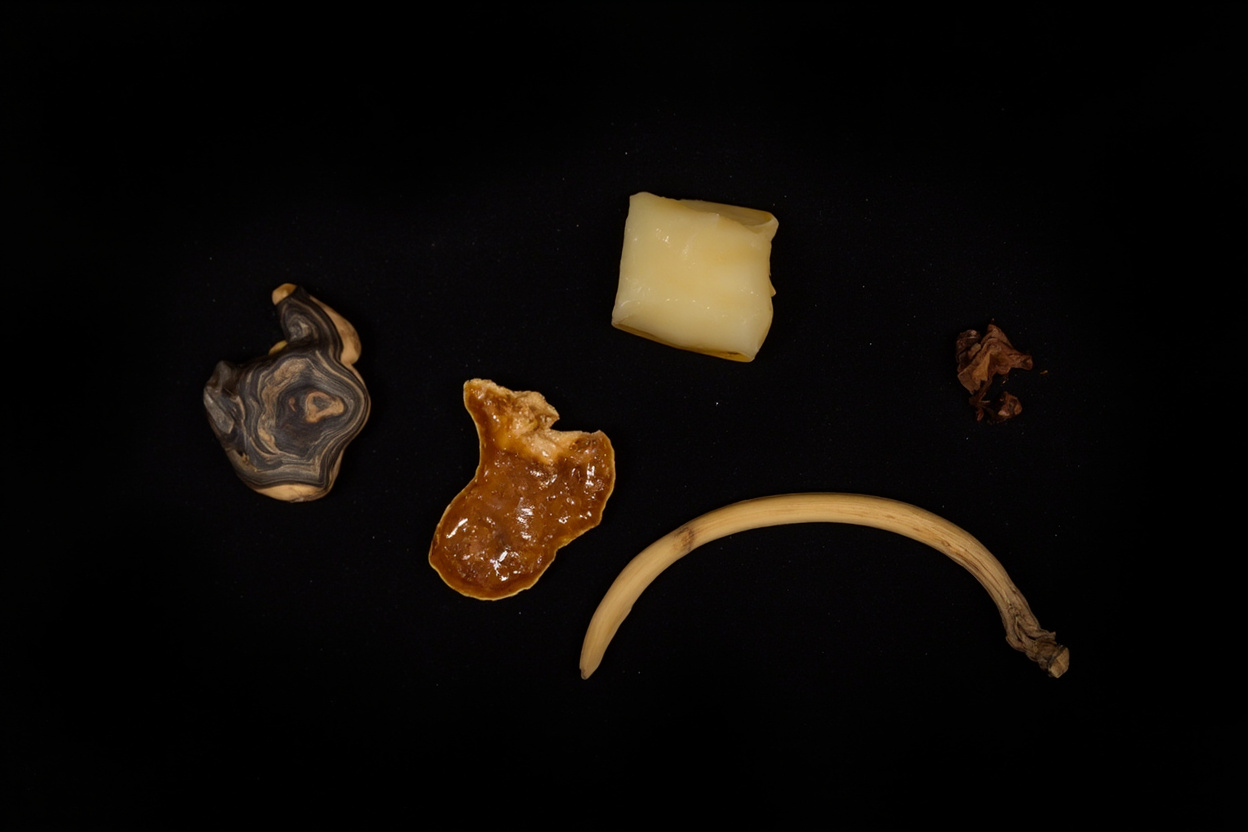
There are hundreds of aromatic materials used in Chinese incense. But only four sit at the very top. These are the ones collectors obsession over, the ones that cost serious money, and the ones every incense enthusiast should know by heart.
The concept of 四大名香 (Si Da Ming Xiang) — the Four Great Fragrances — has been central to Chinese incense culture since at least the Tang Dynasty. These four materials: agarwood, sandalwood, ambergris, and musk, form the foundation of classical Chinese incense. Everything else is an embellishment.
The Four Great Fragrances in Classical Texts
The 本草纲目 (Compendium of Materia Medica) by Li Shizhen discusses all four materials extensively. So does the 陈氏香谱 (Chen Family Incense Manual) from the Song Dynasty. These texts established the theoretical framework that still governs how Chinese practitioners understand and categorize aromatic materials.
李时珍《本草纲目》:「沉香、檀香、麝香、龙涎香,为香中之最上者。」
Li Shizhen wrote: “Agarwood, sandalwood, musk, and ambergris are the highest quality among all fragrances.”
1. Agarwood (Chen Xiang, 沉香) — The King
No incense conversation starts anywhere else. Agarwood comes from Aquilaria trees — but only when they have been wounded or infected. The tree’s defense response produces a dark, resin-soaked heartwood that smells extraordinary. This process can take decades, sometimes centuries.
The Chinese call it 沉香 (Chen Xiang), which literally means “sinking fragrance.” Good agarwood is so dense it sinks in water. This is how Chinese practitioners have tested authenticity for over a thousand years.
Grades and Origins
Agarwood quality depends on how deeply the tree was infected and how long the resin has been developing. The finest grades come from Vietnam, Cambodia, and海南 (Hainan) in China. Each origin produces a distinct fragrance profile:
- 越南沉香 (Vietnamese): Complex, layered, often with fruity notes
- 柬埔寨沉香 (Cambodian): Strong, bold, with earthy undertones
- 海南沉香 (Hainan): Sweet, delicate, prized by Chinese connoisseurs
What it smells like: Depends on the grade. Low grade: woody, slightly sweet. High grade: layers — fruity, then woody, then something almost fermented, like aged wine. The longer you smell it, the more you find. This is why serious practitioners spend hours with a single piece.
Why it is expensive: Real agarwood takes decades to form. Most trees are cut before they produce any. Supply is genuinely limited. If you see “100% pure agarwood” for $5 per stick, it is fake. There is no synthetic equivalent that captures the complexity.
Best for: Everything. Meditation, sleep, focus, ritual. There is no wrong time for agarwood. Classical texts describe it as suitable for all occasions — from imperial court ceremonies to personal meditation.
How to Identify Real Agarwood
The oldest test is the water test: true agarwood sinks. Modern tests include examining the oil spots (油点) on broken surfaces and the characteristic燃烧 pattern. Low-grade agarwood burns with a bright flame; high-grade smolders slowly with minimal flame, releasing smoke continuously.
2. Sandalwood (Tan Xiang, 檀香) — The Foundation
If agarwood is the king, sandalwood is the queen. Where agarwood surprises with complexity, sandalwood comforts with consistency.
True sandalwood comes from Mysore, India (now heavily restricted due to overharvesting) and Hawaii. Australian sandalwood (Santalum spicatum) is more available but different in character — sharper, less creamy. Chinese practitioners generally prefer Indian sandalwood for traditional formulas, though premium Australian product has gained acceptance.
What it smells like: Creamy, warm, slightly sweet. Think of the smell of a wooden box that holds something precious. That is sandalwood. It is immediate and recognizable — most people can identify it after one exposure.
Why it matters: It is the most consistent. Unlike agarwood which varies wildly between batches, quality sandalwood delivers reliably. Most beginner-friendly incense starts here because it teaches your nose what “good” smells like without overwhelming complexity.
Best for: Beginners. Sleep. Daily burning. Anyone who wants something pleasant without complexity. Classical texts describe sandalwood as particularly suitable for calming the spirit and aiding meditation.
Sandalwood in Classical Formulas
The 陈氏香谱 lists sandalwood as a base material in dozens of classical formulas. It serves as both a fragrance material and a fixative — slowing the evaporation of more volatile components. A typical classical hexiang (blended incense) might contain 40-60% sandalwood as the foundation.
3. Ambergris (Long Xian Xiang, 龙涎香) — The Mysterious One
Ambergris is… complicated to explain. Officially: a waxy substance produced in the digestive system of sperm whales. Unofficially: one of the most complex scent materials in the world.
Yes, it is unusual. And no, you will not find it in cheap incense. But a tiny amount transforms a blend completely. Classical Chinese incense formulas often call for just a few drops of ambergris tincture per pound of base material.
What it smells like: In its raw form: fecal, ocean, maritime — not pleasant. After aging and processing (sometimes years of aging in alcohol): sweet, warm, animalic, with a fixative quality that makes other scents last for hours longer. Think: the difference between a perfume and that same perfume with three drops of ambergris base.
Why it is expensive: Finding floating ambergris at sea is pure luck — perhaps one piece in every few hundred sperm whales. Processing it takes years. Modern synthetic alternatives (ambroxan, ambrinol) exist but are not the same. A single ounce of quality ambergris tincture can cost hundreds of dollars.
Best for: As a定香剂 (fixative) in blends. A tiny amount (think: single drops of tincture per pound of incense) extends the life and complexity of your entire incense experience. Classical texts describe it as essential for “completing” a blend.
The History of Ambergris in China
Chinese texts from the Tang Dynasty describe 龙涎香 as an imported luxury, transported along the Maritime Silk Road from African and Arabian waters. It was so prized that emperors maintained exclusive supplies. The name “dragon spittle fragrance” (龙涎) suggests the Chinese imagined it as the solidified saliva of sea dragons.
4. Musk (She Xiang, 麝香) — The Heartbeat
Traditional musk comes from the musk deer (Moschus species), found in the Himalayan region and Central Asia. The deer produces musk in a gland to mark territory; this substance was harvested — sadly, usually by killing the animal.
Today, genuine musk deer musk is endangered and internationally trade-restricted. Modern versions are synthetic (galaxolide, musk ketone) or botanical — cypriol, ambrette seed, and angelica root give similar effects without the ethical concerns. Some practitioners consider botanical alternatives actually superior for environmental reasons.
What it smells like: Animalic, warm, slightly sour at first, then sweet as it develops. It gives incense a “living” quality — the difference between a painting of a forest and actually standing in one. Musk makes a blend feel unified rather than layered.
Why it matters: Musk acts as a bridge. It connects the other notes and makes them feel unified. Most complex incense blends contain at least a trace of musk. Classical texts describe it as the “heart” of incense — the element that makes all the other materials work together.
《香学会疏》:「麝香为香之魂,能通诸经,入心脾。」
The Xiang Xue Hui Shu states: “Musk is the soul of incense; it penetrates all meridians and enters the heart and spleen.”
Best for: Blending. You rarely burn musk alone. But in a blend? It changes everything. Even 1-2% musk in a formula can transform the character completely.
How to Use This Knowledge
Understanding the Four Great Fragrances is essential for anyone serious about Chinese incense. Here is how to apply this knowledge:
Start with Sandalwood
It is accessible, reliable, and teaches your nose what “good” smells like. Find a pure sandalwood incense (not a “scented” stick with synthetic fragrance) and burn it daily for a week. After that, you will know the baseline.
Then Try Agarwood
Begin with low-grade (less expensive) to calibrate your palate, then work up to premium. Chinese practitioners say your nose needs training — start with simpler materials before tackling the most complex.
Find the Four in Blends
Ambergris and musk: look for them in blends. When you find a blend that smells particularly “complete” — like it has depth that lasts for hours — check the ingredients. You will probably find one or both hiding in there.
Build Your Collection Gradually
These four materials have been at the center of Chinese incense culture for centuries. They will still be here centuries from now. There is no rush. Build your collection gradually, learning each material’s character before moving to complex blends.
Frequently Asked Questions
What are the Four Great Fragrances in Chinese incense?
The Four Great Fragrances (四大名香) are agarwood (沉香), sandalwood (檀香), ambergris (龙涎香), and musk (麝香). These have been the foundational materials of Chinese incense since at least the Tang Dynasty.
Why is agarwood so expensive?
Agarwood forms over decades when Aquilaria trees are wounded or infected. Most trees are harvested before the resin develops properly. Supply is genuinely limited, and there is no synthetic equivalent that captures the complexity.
Can beginners start with any of the Four Great Fragrances?
Start with sandalwood. It is the most consistent and accessible. Agarwood is more complex and expensive, so save it for when your palate has developed.
Is real musk ethical?
Traditional musk deer musk is endangered. Look for botanical alternatives (cypriol, ambrette seed) or high-quality synthetics. These provide similar effects without harming wildlife.
What is the most important of the Four Great Fragrances?
Agarwood is generally considered the most prized — and expensive. But Chinese practitioners would say all four are essential. Musk “activates” blends, sandalwood provides consistency, ambergris extends duration, and agarwood delivers the core fragrance experience.