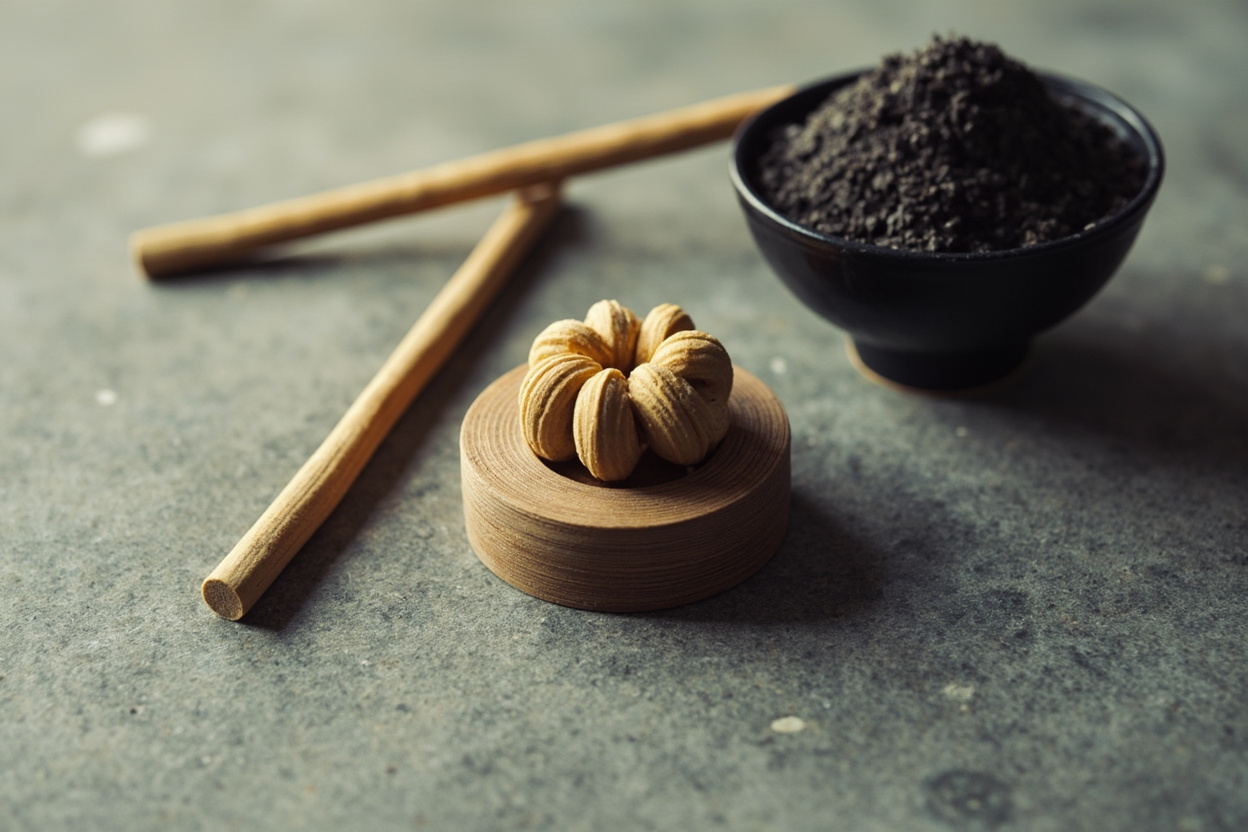
You walk into a shop or browse online and there are three main forms: sticks, coils, and powder. They’re not interchangeable. Each has a purpose, a character, and a right time to use it. Understanding the differences will save you money and frustration.
Stick Incense (Xian Xiang)
The most common form. A thin stick of compressed incense material — usually with a bamboo core, though “hapto” sticks (without bamboo) exist for premium grades.
Burn time: 20-45 minutes depending on thickness and material. Standard “joss sticks” burn in 20-30 minutes. Thicker “premium” sticks can go 40-60 minutes.
Best for:
- Daily, casual burning
- Short meditation sessions
- When you want to manage burn time precisely
- Beginners — easiest to use
Not great for: All-day burning (you’d need to relight constantly). Large rooms (single stick rarely fills a big space adequately).
Key varieties:
- Bamboo-core sticks — most common, affordable, the “standard” you see everywhere
- Hapto/coreless — no bamboo, all material, burns more evenly, produces less smoke, more expensive
- Self-lighting — has a built-in ignition layer at the base, lights with a match and stays lit, good for ritual use
Coil Incense (Pan Xiang)
Looks like a flat spiral, similar to a蚊香 (mosquito coil). Burns from the outer end toward the center, which is why it can last so long.
Burn time: 1 hour to 8 hours depending on thickness and material. Some large temple coils can burn for days.
Best for:
- Long work sessions — burn while you work at your desk
- Large spaces — temples, living rooms, outdoor areas
- When you don’t want to monitor the incense at all
- Continuous background fragrance over many hours
Not great for: Quick sessions, meditation where you want to control the burn, anywhere with significant airflow (outdoor use can cause uneven burning or blow the ash off).
Powder Incense (Xiang Fen)
The least understood but most versatile form. Fine powder that you burn on charcoal or in a specialized vessel.
Burn method: Indirect. Place powder in or on a censer over glowing charcoal. The material doesn’t touch the flame — heat releases the scent.
Burn time: Depends on how much you use, but typically 30-60 minutes per charcoal session.
Best for:
- The purest, cleanest incense experience — no bamboo smoke, no paper wrapper
- Blending — easy to mix powders to create custom blends
- Premium raw materials — many high-end agarwood and resin incenses are sold as powders
- Serious practitioners who want the full sensory range of a material
Not great for: Convenience. Requires charcoal, a censer or bowl, more setup and cleanup than sticks. Not appropriate for beginners or casual use.
The Practical Comparison
Here’s a quick way to think about it:
- I’m new to this and just want to try it → Stick incense (bamboo core, sandalwood, under $15)
- I meditate for 20 minutes daily → Stick incense, hapto or thin bamboo-core
- I want my whole apartment to smell good while I work → Coil incense, one of the larger ones
- I’m serious about Xiangdao and want to explore premium materials → Powder incense on charcoal
- I want to create my own blends → Powder incense
- I’m burning for a specific ritual or ceremony → Depends on length; short ceremony = sticks, long ceremony = coil
Mixing Forms
There’s no rule saying you can only use one form. Some practitioners:
- Burning a coil on their desk for all-day background fragrance
- Lighting a stick for their 20-minute morning meditation
- Using powder on charcoal for special evening sessions when they want the full experience
Each form serves a different function. Once you understand what each is good for, you can build a practice that uses all three strategically.
The Quality Question
Form doesn’t determine quality — but it affects what quality means. In stick form, cheap materials are easy to hide (bamboo core plus minimal incense coating). In powder form, quality is harder to fake — you can see and smell exactly what you’re getting. A $5 bag of powder incense is almost certainly better than a $5 box of stick incense.
Don’t assume premium price tags mean premium quality. But don’t assume cheap prices mean poor quality either. Some of the best incense experiences I’ve had came from simple materials used properly — a tiny amount of quality powder on charcoal, burned in the right space, beats a $50 premium stick burned in a drafty room.