
You are at your desk. Three hours of meetings behind you, two more ahead. The afternoon slump is real — that heaviness behind your eyes, the difficulty focusing on anything that requires actual thought. You have tried coffee. You have tried stepping outside. You have tried just pushing through. What you have not tried: burning incense at your workspace.
Traditional Chinese incense is not just for temples or meditation halls. It has been used in scholarly and professional settings for centuries. The aroma does something to the space — and to the people in it — that synthetic air fresheners cannot replicate.
Why Incense Works in Professional Settings

The Western office has accepted candles, diffusers, and scented candles. But incense still carries a strange reputation — as something religious, or esoteric, or just too different. This is a mistake.
The Bencao Gangmu and other classical texts describe specific aromatics as having “clear head” properties. When you burn sandalwood in a closed room, the compounds released actually have measurable cognitive effects. Not smell-good effects. Actual cognitive effects on focus and alertness.
Sandalwood contains santalol, which has been studied for its anxiolytic and cognitive effects. It does not make you drowsy. It settles scattered energy into something more manageable.
The Practical Setup
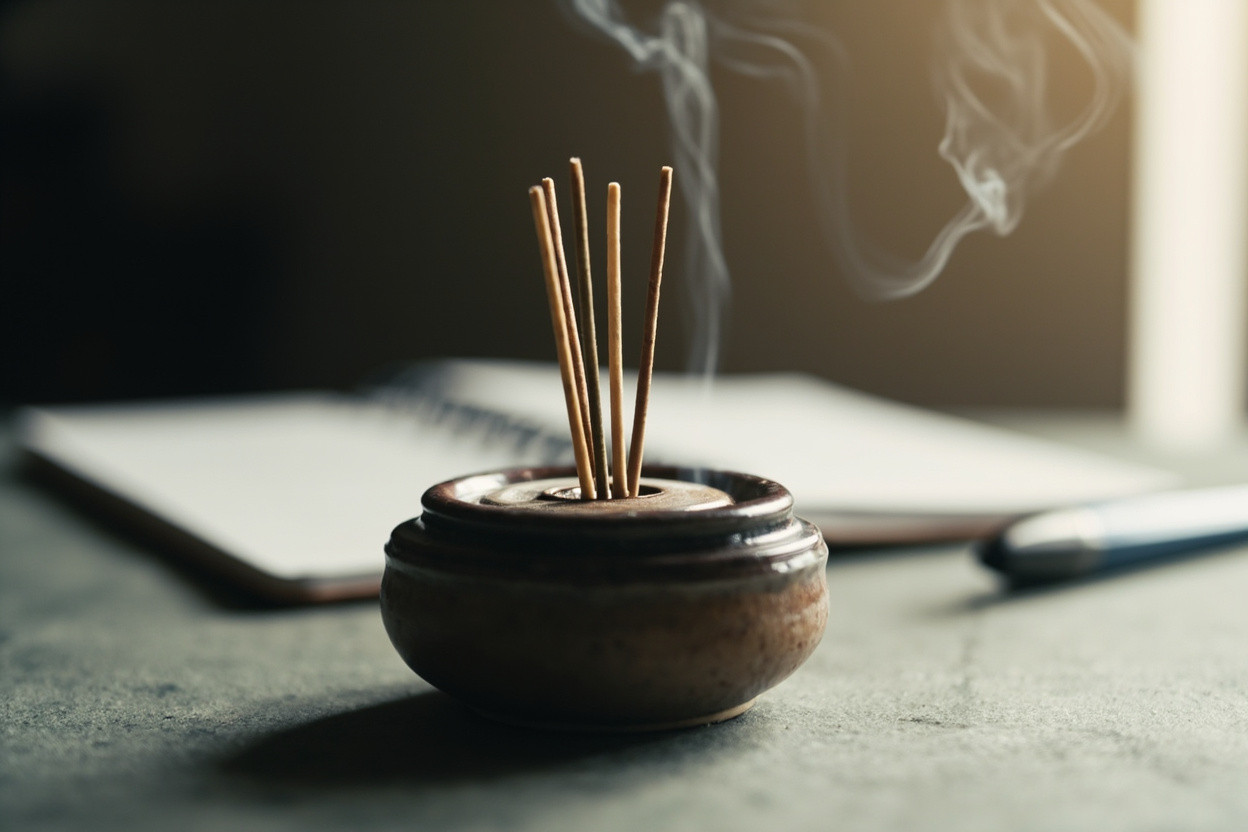
You need three things: an electric incense burner (no smoke, no flame, no fire alarm issues), a well-ventilated space (open a window six inches — that is enough), and the right incense.
The burner goes on your desk, at least two feet from where you sit. Point it away from your face. The aroma should reach you indirectly, like background music for your sense of smell.
Amount: 0.2 grams. Less than you think. You are not trying to fill the room with smell. You are trying to establish a subtle aromatic environment that supports focus without becoming noticeable.
The Best Incense for the Office
Sandalwood (檀香) — The default choice for professional settings. Settles without sedating. Clears mental fog without making you sleepy. The benchmark against which all other cognitive incenses are measured.
Agarwood (沉香) — If you have the budget. The complexity of aroma is unmatched — layers that reveal themselves over time. Colleagues will notice something pleasant without being able to identify it.
Cedar (雪松) — If sandalwood feels too soft for your workplace culture. More assertive, more grounding. Good for environments where you need to project authority and clarity.
Lotus (莲花) — For creative professionals. The aroma has associations with clarity and insight in classical texts. Subtle enough for shared spaces.
When to Burn
Not all day. That is the first rule. Incense loses its effect if you are continuously exposed to it. The goal is to use it strategically.
Two optimal windows: mid-morning (around 10 AM) when the initial coffee energy is fading, and early afternoon (1-2 PM) when the post-lunch slump hits. Burn for 20-30 minutes. The effects last 60-90 minutes after you stop.
Never burn incense during client calls or video meetings unless you know for certain your colleagues are comfortable with it. The professional environment still has norms to navigate.
The Cultural Context
Incense has been part of Chinese scholarly life for over two thousand years. The Scholar official burning incense while writing was not a luxury — it was standard practice. The aroma was considered essential to creating the mental environment necessary for serious intellectual work.
You are not being exotic or different by burning incense at work. You are participating in a very old tradition of professionals who understood that environment affects cognition, and that aromatic environment is part of the controllable variables.
Frequently Asked Questions
Will my coworkers complain?
Probably not, if you use an electric burner with no visible smoke and keep the ventilation open. The aroma should be subtle enough that only people within a few feet notice it. Start with sandalwood — it is the most universally accepted fragrance.
Is it safe to burn incense in an office?
With an electric burner, yes. No flame, no smoke particles, no fire risk. As long as you have ventilation (open a window), it is safer than burning a candle, which produces more particulate matter.
What if my office has a scent-free policy?
Then you have a scent-free policy. Respect it. This guide assumes you work in an environment where moderate aromatic discretion is acceptable. If you do not, do not push it.
Related Articles
Try It Tomorrow Morning
Tomorrow at 10 AM, when your focus starts to slip and the coffee is not helping: 0.2 grams of sandalwood on your electric burner, window cracked, burner pointed away from your face. Set a 25-minute timer. See what happens when you work with your cognitive biology instead of against it.