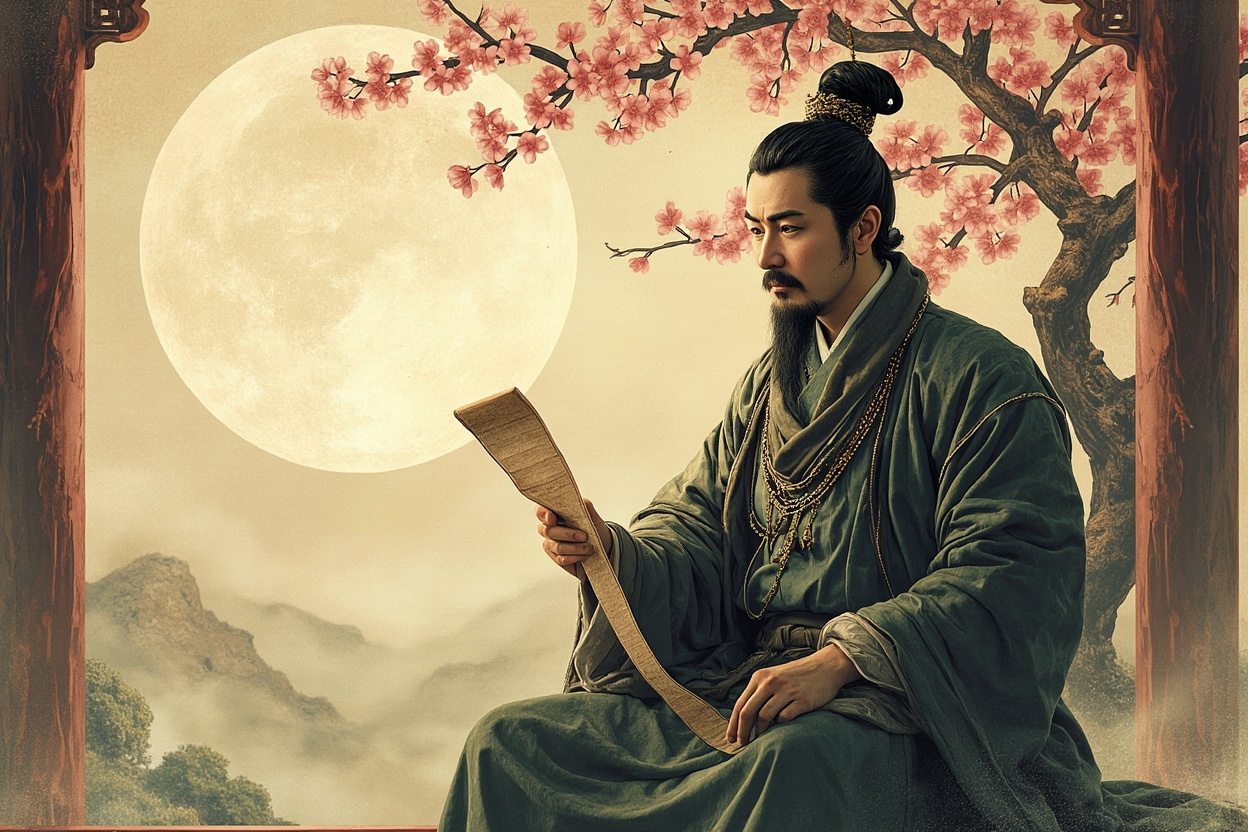
In the twilight of the Southern Tang dynasty, when the empire stretched across China’s southern provinces and poetry flowed like wine at palace banquets, there ruled an emperor who is remembered more for his verses than his conquests. Li Yu (李煜, 937-978), the last sovereign of Southern Tang, spent his nights composing some of Chinese literature’s most aching love poems. By day, he turned his court into a perfumery.
The result was Li Zhu Hua Jin (李主花浸沉香) — “The Last Emperor’s Flower-Infused Agarwood.” It is one of the most romantic recipes in the Chinese incense tradition: agarwood slowly steeped in the essence of spring blossoms, absorbing the spirit of the season until the wood itself seems to bloom.
Who Was Li Yu?
Li Yu ascended to the throne in 961 AD, inheriting a kingdom that spanned modern-day Jiangsu, Anhui, Jiangxi, Hubei, and parts of Fujian and Sichuan. His reign was brief and turbulent. Within years, the Song dynasty forces closed in from the north. Li Yu would eventually surrender, spend his final years under house arrest in the Song capital of Kaifeng, and die at forty-two — likely by poisoning.
But before the end came, Li Yu lived extravagantly. His court gathered the finest scholars, musicians, painters, and craftspeople in all of China. The emperor himself played the guqin, painted scroll after scroll of mountain landscapes, and wrote poems that would define the lyrical sensibility of an entire civilization.
Among his many preoccupations was the art of incense. While most Chinese emperors commissioned grand ceremonies — vast quantities of temple incense for Buddhist rituals, palace blends for court audiences — Li Yu did something different. He sat in his garden and thought about how to capture a flower in wood.
The Recipe from Xiang Cheng
The formula for Li Zhu Hua Jin survives in Zhou Jiazhou’s Xiang Cheng (香乘, “The乘 of Incense,” 1628), the most comprehensive treasury of Chinese incense knowledge compiled during the Ming dynasty. Zhou recorded the recipe as follows:
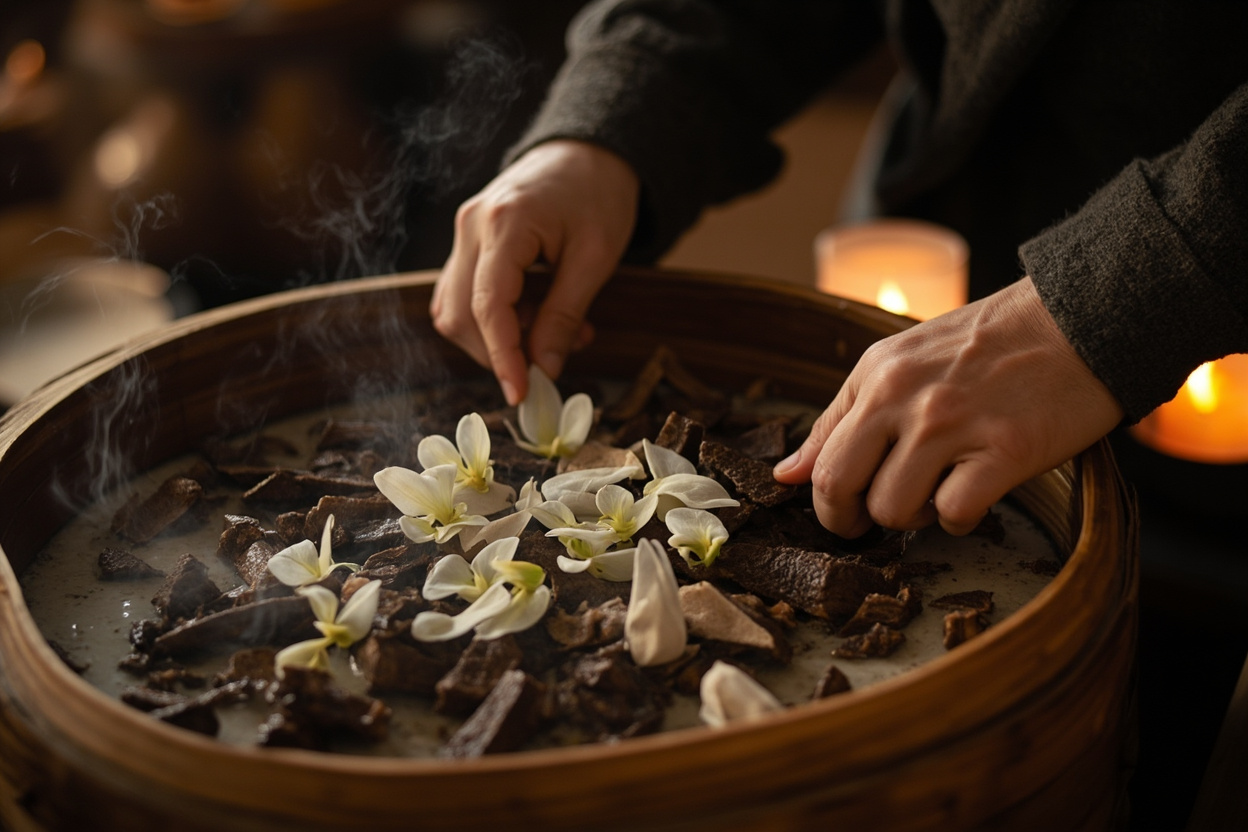
沉香不拘多少剉碎,取有香花若酴醾、木樨、橘花(或橘叶亦可)、福建茉莉花之类,带露水摘花一盌,以瓷盒盛之,纸盖入甑蒸食顷,取出,去花留汗,汁浸沉香,日中暴干,如是者数次,以沉香透烂为度。或云皆不若蔷薇水浸之最妙。
Translation: Take agarwood (沉香) in any quantity and break it into small pieces. Take fragrant flowers — rose (酴醾), osmanthus (木樨), orange blossom (橘花, or orange leaves), or Fujian jasmine — picking one bowl of them with morning dew still on the petals. Place them in a porcelain container, cover with paper, and steam in a steamer for the length of a meal. Remove, discard the flowers but keep the infused liquid. Soak the agarwood in this juice and dry it in the sun. Repeat this several times until the agarwood is thoroughly infused and soft. Some say nothing surpasses using rose water (蔷薇水) for soaking — that is the finest method.
What the Recipe Means
The Xiang Cheng’s description sounds almost like cooking — and in a sense, it is. The process is essentially a slow infusion: flower essence penetrating wood, over and over, sun-drying between each cycle. The classical Chinese term for this is 浸 (jin), meaning to soak or steep. Combined with 花 (hua, flower) and 沉香 (chenxiang, agarwood), the name literally translates to “flower-soaked agarwood of the ruler.”
Several details deserve attention. First, the choice of flowers: rose, osmanthus, orange blossom, and jasmine. These are all highly fragrant flowers common in southern China, each with a distinct character. Rose is rich and deep; osmanthus is sweet and honeyed; orange blossom is fresh and slightly bitter; jasmine is heady and narcotic. Any one of them — or a blend — would impart very different qualities to the final wood.
Second, the word 露水 (dew water/lùshuǐ) is significant. Dew collected in early morning was considered the purest water — uncontaminated by earth, carrying the gentle essence of the heavens. Using dew rather than plain water in incense preparations was common in classical Chinese pharmacy and perfumery, reflecting a belief that natural timing and purity mattered as much as the ingredients themselves.
Third, the repetition. A single steeping yields some fragrance. But Zhou Jiazhou specifies 数次 (several times), until the agarwood is “透烂” (completely saturated and softened). This is patient work — days or weeks of cycles — producing an agarwood that carries flower not as surface coating but as deep internal character.
Fragrant Flowers of the Recipe
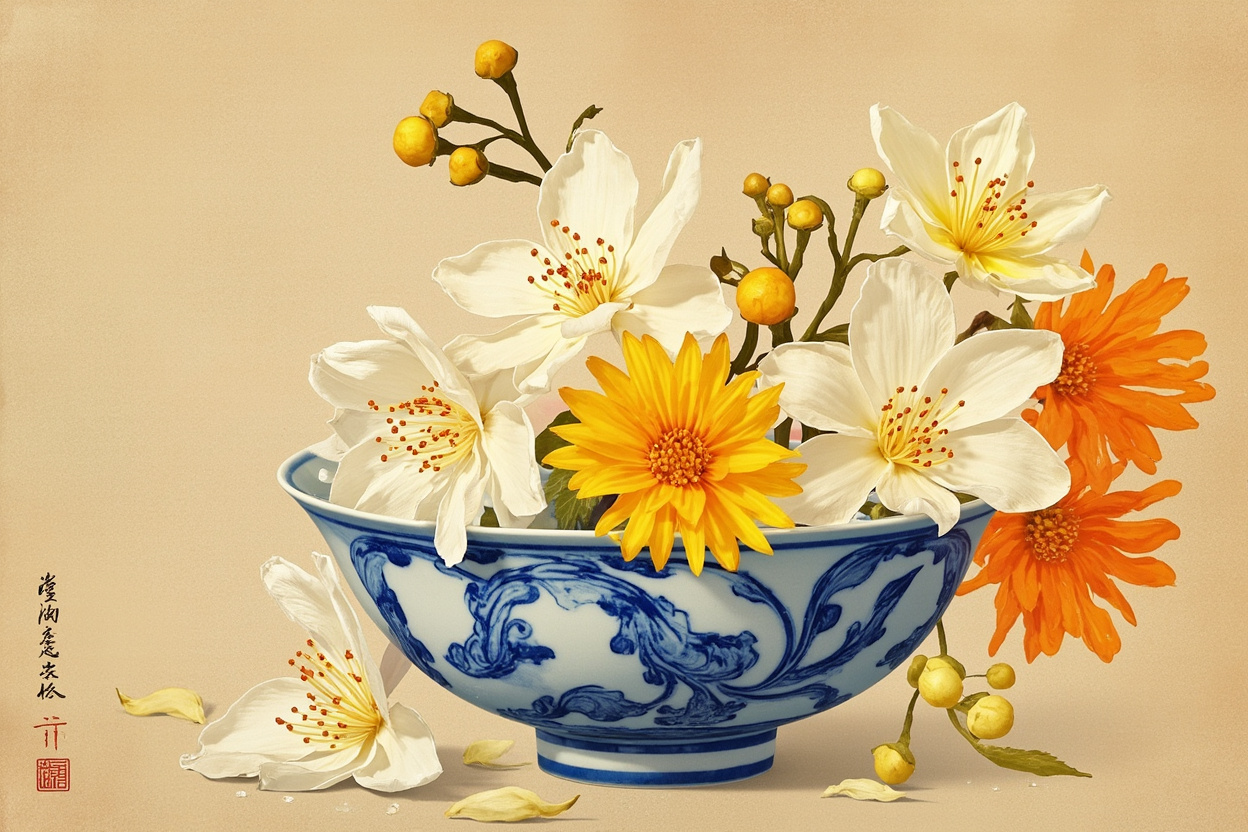
Each flower in the recipe carries its own symbolic weight in Chinese culture:
- 酴醾 (tú mí) — Rose or Rose-like flower: In Song dynasty gardens, tú mí referred to large climbing roses or similar double-flowered cultivars. Their rich fragrance made them prized for decorative and aromatic use alike.
- 木樨 (mù xī) — Osmanthus: The golden or orange osmanthus flowers small but intensely fragrant, perfuming entire gardens in autumn. Associated with longevity and nobility in Chinese tradition.
- 橘花 (jú huā) — Orange blossom: The white flowers of the mandarin orange tree, delicate and citrusy, symbolizing purity and renewal.
- 福建茉莉花 (Fujian jasmine): Southern China’s warm climate produced jasmine with especially rich scent. Fujian jasmine was famous across China as a premium aromatic.
Reconstructing Li Zhu Hua Jin Today
Modern reconstructions of this recipe face a practical question: agarwood of sufficient quality is extraordinarily expensive, and the multi-week steeping process requires patience most contemporary makers cannot commit. Still, the spirit of the recipe — slow infusion of flower into wood — can be approximated.
A common modern approach substitutes the steaming step with high-quality organic rose water or osmanthus hydrosol, combined with wood chips or low-grade agarwood dust. The mixture sits in a sealed glass container for two to four weeks, shaken daily, then spread in thin layers to dry in shade. The process can be repeated three to five times.
The result is not the same as Li Yu’s original — nothing truly is — but it carries an echo of the same impulse: to take something living (flower) and something ancient (agarwood) and unite them into a single fragrance that holds both spring and eternity.
How to Use Li Zhu Hua Jin
Finished Li Zhu Hua Jin can be used as any high-grade powdered incense: placed in a censer with direct heat from charcoal, or rolled into incense sticks with a binding agent. Because the agarwood has already absorbed flower essence, it burns with a complex layered scent — the deep, woody sweetness of chenxiang threaded through with the bright, living fragrance of blossoms.
In classical practice, this blend would have been burned during intimate palace gatherings: small circles of literati and musicians, the night air carrying both verse and smoke. Today, it serves equally well in a quiet room for meditation, or as a companion to reading Chinese poetry.
FAQ
What does “Li Zhu” mean in the name?
“Li Zhu” (李主) means “Lord Li” or “Emperor Li,” referring to Li Yu (李煜), the last ruler of Southern Tang dynasty. He was known both as a poet and patron of the arts, including incense making.
Can I make this recipe without real agarwood?
High-quality agarwood is rare and expensive. You can substitute with inexpensive agarwood chips or even sandalwood chips, though the result will lack the depth of character that genuine chenxiang provides. The core technique — slow flower infusion — still works with any aromatic wood.
What flowers work best for this recipe?
Fresh organic roses and osmanthus produce the most authentic results. Jasmine and orange blossom also work well. The key is fragrance intensity — use the freshest, most aromatic flowers available, ideally collected in early morning.
How long does the full reconstruction process take?
Plan for at least three to four weeks for a basic reconstruction, accounting for multiple steeping and drying cycles. Each cycle involves soaking for 48-72 hours and sun-drying for a day. Full saturation of the wood requires patience.
Is Li Zhu Hua Jin mentioned in any historical texts besides Xiang Cheng?
The recipe is primarily documented in Zhou Jiazhou’s Xiang Cheng (1628). Some scholars believe the formula circulated among Southern Tang court circles before Li Yu’s reign, and that he may have refined or popularized rather than originated it.