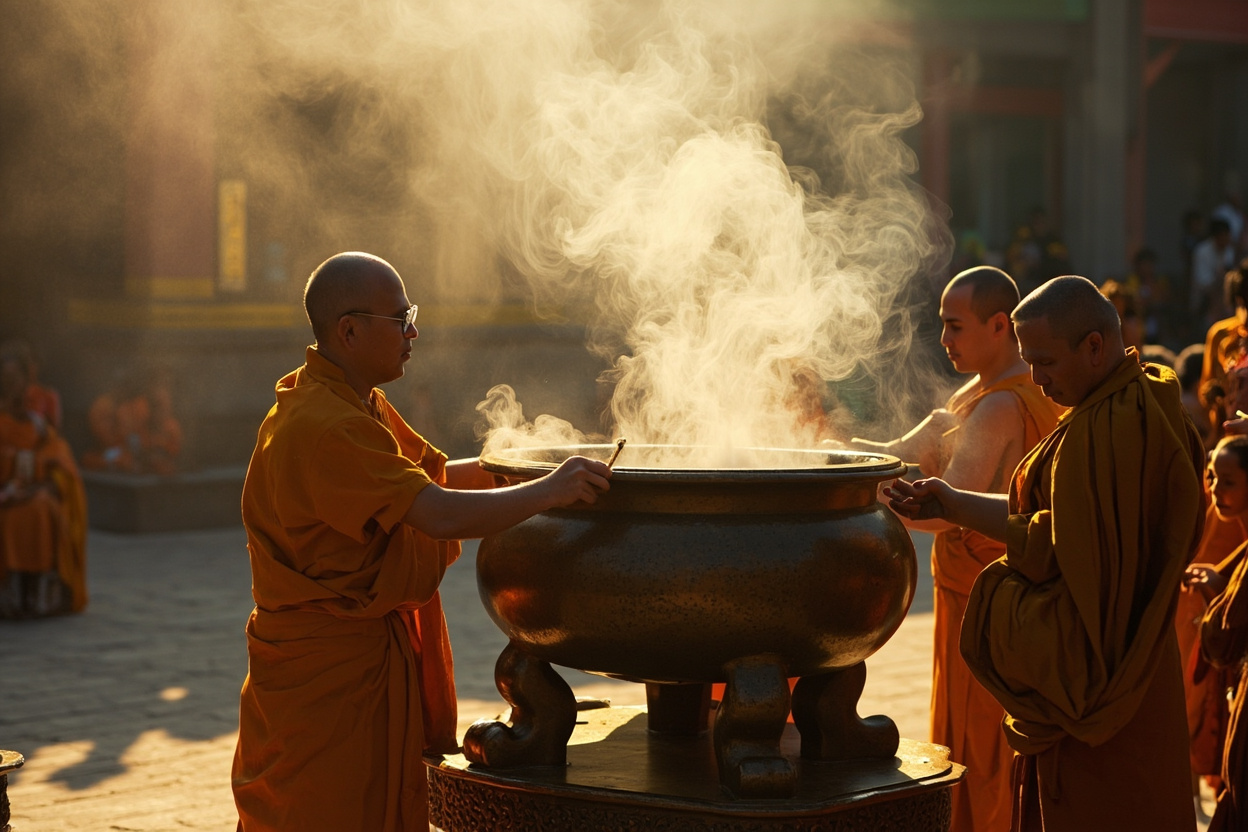
You walk into any Buddhist temple in Asia. The first thing that hits you isn’t the architecture, the statues, or the monks. It’s the smell. Incense has been inseparable from Buddhist practice since the tradition began, and the connection runs deeper than most people realize.
The Earliest Connections
Buddhist incense practices predate the religion itself. Archaeological evidence from Nubia (modern Sudan) shows incense burners in use around 3300-3000 BCE—predating Buddhism by roughly 5,000 years. Incense was central to ancient Egyptian, Mesopotamian, and Indian religious practices. When Buddhism emerged in India around the 5th century BCE, it inherited and adapted these existing traditions.
The Buddha himself is said to have been offered incense (specifically, kundum or sandalwood) by merchants shortly after his enlightenment. The earliest Buddhist texts reference incense as one of the five scents honored by Buddhist practitioners.
Why Incense in Buddhist Practice?
Three reasons, deeply interconnected:
1. Offerings (puja). Incense is one of the most common Buddhist offerings—along with flowers, light (candles), food, and water. Unlike food offerings, incense doesn’t need to be consumed or disposed of. It transforms into smoke, carries prayers upward (in traditional cosmology), and fills the space with presence.
2. Meditation aid. The smoke becomes a visual focus—a living, changing element that mirrors the nature of all things: impermanent, arising and passing. Practitioners also use specific scents (sandalwood, agarwood) believed to calm the mind and support concentration. This isn’t superstition; the connection between smell and the limbic system is well-documented.
3. Purification. Traditional Buddhist cosmology describes negative forces and malevolent spirits. Burning incense was believed to counteract these influences—much as it was used in ancient Egyptian and Mesopotamian contexts. Even without accepting this cosmology, there’s a psychological dimension: a space filled with pleasant fragrance feels sacred, set apart from ordinary life.
Incense Across Buddhist Traditions
Buddhism spread along trade routes, and each culture adapted incense practices to local materials and beliefs:
Chinese Buddhism developed particularly rich incense culture, integrated with ancestor veneration and Pure Land practices. Temple incense is typically a blend—often involving sandalwood, frankincense, and dragon well benzoin. Large communal censers in temple courtyards burn throughout the day.
Tibetan Buddhism uses juniper (Juniperus) as a primary incense material—abundant in the Himalayan region and deeply embedded in pre-Buddhist Bön traditions. Tibetan blends are often herbal and smoke heavily. Prayer flags are also treated with incense during ceremonies.
Japanese Buddhism influenced Kodo (the way of incense)—the Japanese developed incense into a more contemplative, aesthetic practice focused on sensory discrimination and appreciation rather than ritual offering. Japanese temple incense tends to be subtle, refined, single-material or minimal blends.
Theravada Buddhism (Sri Lanka, Thailand, Myanmar) uses local materials including eaglewood (aquilaria, related to agarwood), coconut shell charcoal, and various resins. Thai Buddhist incense is often jasmine-scented, reflecting the abundance of jasmine in Southeast Asia.
The Smoke Itself: Symbolic Meanings
Buddhist commentary on incense smoke is unexpectedly precise:
- The smoke rises upward = aspirations toward enlightenment, toward the Buddha realm
- The fragrance spreads in all directions = the Buddha’s teachings reaching all beings equally
- The smoke is invisible in the end = all phenomena return to emptiness (śūnyatā)
- The source (the burning material) is consumed but the fragrance remains = the ego is burned away but virtue remains
What This Means for Your Practice
You don’t need to be Buddhist to burn incense in a Buddhist context—or to draw on Buddhist incense traditions for your own practice. Some practical connections:
If you meditate, try burning a small amount of sandalwood or a light Buddhist temple blend before sitting. The ritual of lighting, the settling of the smoke, the change in room atmosphere—these signal to your nervous system that it’s time to shift states. The Buddhist monks weren’t wrong to notice this effect; they formalized it thousands of years ago.
For more on the meditative dimension, explore our guide to incense for meditation.
The One Thing to Remember
Buddhist incense practice isn’t about the incense itself. The incense is a support, an aid, a reminder. The real practice is attention, compassion, and the cultivation of wisdom. When you burn incense—whether in a temple or your apartment—and feel that subtle shift toward presence, that’s the actual point. Everything else is just smoke.