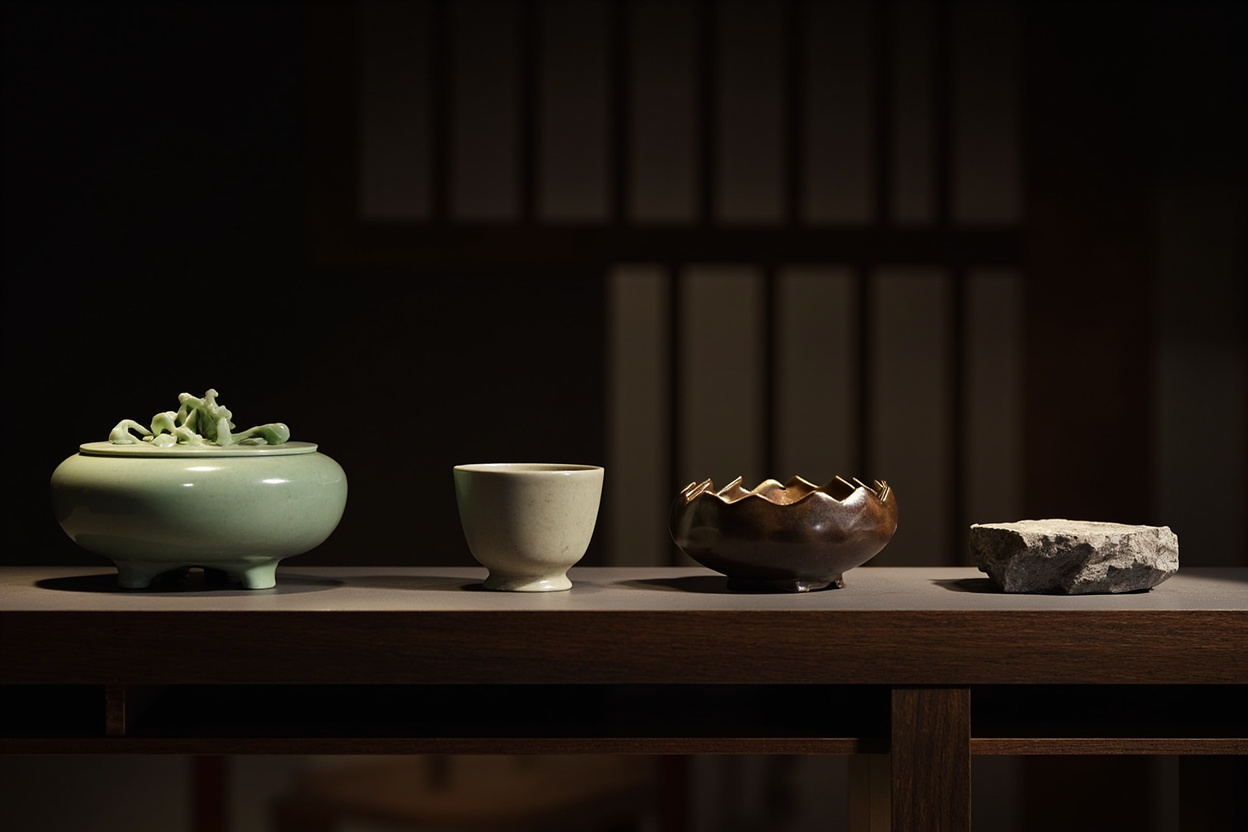
You light a stick. It falls over. The ash scatters. Your table gets a burn mark. This is not an uncommon first experience with incense, and it’s entirely avoidable. The right holder doesn’t just look good—it makes the entire practice safer and more enjoyable.
Why the Holder Matters
An incense holder (香炉, xianglu) does three jobs:
- Stabilizes the stick so it doesn’t fall
- Catches ash as it falls
- Contains the ember at the tip
A $3 holder from a local import shop does all three. A $300 antique does all three. The difference is material, craftsmanship, and aesthetics. Functionally, you don’t need to spend more than $10-20 to get something that works perfectly.
The Main Types
1. Stand/Rest (香插, Xiang Cha)
The simplest type: a base with a hole or prong to hold the stick at an angle. For stick incense only. Good for beginners. Usually ceramic or wood. Wide-based models are more stable than tall, thin ones.
Look for: base weight of at least 200g, hole diameter that fits your stick size (most are universal, some are for thinner “joss” sticks only).
2. Bowl Burner (香盆, Xiang Pen)
A shallow bowl filled with sand or ash. The stick sticks into the sand. Sand absorbs heat and catches all the ash. This is the most practical design for beginners and experts alike. Ash disposal is easy—just replace the sand periodically.
Look for: ceramic or metal bowl, at least 10cm diameter, sand specifically sold for incense use (regular beach sand can contain impurities).
3. Bronze Censer / Boshanlu (博山炉)
The classic Chinese incense burner. Boshanlu literally means “mountain of knowledge censer”—the lid is shaped like a mountain with openings from which smoke emerges. Developed during the Han Dynasty (206 BCE – 220 CE) and became the most iconic form of Chinese incense burner.
For: display, serious collectors, ritual use. Not necessarily better for function than a bowl—but significantly better for aesthetics and traditional aesthetics. Modern reproductions range from $30-200. Antique originals can be worth thousands.
4. Charcoal Burner (香炉 for Powder/Resin)
For burning powder incense, resins, or small wood chips. Uses charcoal as a heat source. The material is placed in a small bowl on top of or beside glowing charcoal. This is indirect burning—the material doesn’t touch flame, it releases scent from heat alone.
For: experienced users who want to burn raw materials or premium blends. More setup time, requires charcoal and proper ventilation. The scent quality is generally considered superior to stick incense.
Look for: a censer with an inner bowl for the charcoal and an outer chamber for air circulation. Bronze is traditional; modern versions are often ceramic.
5. Coil Holder (盘香架, Pan Xiang Jia)
Specifically for coil incense (盘香). Usually a metal cone or spike that the coil sits on. Some have a basin at the bottom to catch ash. Since coil incense burns for hours, stability is especially important—coils are heavier than sticks.
Look for: heavy base, ideally sand-filled. The coil should sit securely without needing to be balanced.
6. Lattice/Dragon (龙香炉, Long Xiang Lu)
A specialized holder for very fine powdered incense that needs to burn on a mesh or lattice above a flame. More common in Japanese Kodo practice than Chinese Xiangdao. For advanced users only.
Materials: What to Consider
Ceramic: Most common, affordable ($5-50). Good heat resistance. Wide range of styles. Can crack if exposed to sudden temperature changes. Porous—absorbs fragrance over time (can be a feature or a bug).
Bronze: Traditional, beautiful, durable. Holds heat well. More expensive ($30-200+). Heavy (stable). Develops patina over time—many collectors consider this desirable.
Wood: Usually paired with a metal or ceramic insert for the actual ember. Beautiful but flammable—ensure the insert is deep enough that no flame can reach the wood. Generally $10-40.
Stone (including soapstone): Excellent heat resistance. Heavy and stable. Often used for charcoal burning. Can be expensive depending on the stone. Softer stones (soapstone especially) can absorb oils from incense and develop fragrance over years of use.
Glass: Mostly for show or for liquid incense. Not practical for burning stick incense with flame.
The Most Common Beginner Mistake
Buying a holder that’s too small. The ash falls off the edge. Or buying a holder that’s too light and it tips over. Here’s the test before you buy: can you bump it with moderate force without it falling over? If not, it’s not stable enough.
Second most common mistake: buying a decorative holder with no ash catch. Some beautiful Buddhist-style holders are designed for display use only—ceremonial pieces that aren’t meant to actually burn incense in. Check before you buy.
How to Care for Your Holder
- Bowl/sand holders: replace sand every 1-2 months or when it turns gray from ash. Wash the bowl between sand changes.
- Bronze: occasional polishing with a soft cloth. Don’t use abrasive cleaners— they’ll remove the patina that collectors value.
- Ceramic: don’t submerge in water if it’s porous (unless sealed). Wipe clean with a dry or slightly damp cloth.
- Any holder: the ash catch should be emptied regularly. Wet ash can be compacted and disposed of; never flush incense ash (it contains fine particulate matter).
Spend on Quality or Save for Material?
Here’s a practical framework:
- If you’re trying it out: $5-15 bowl or stand. It works. You learn what you like.
- If you’ve been burning for 3+ months: $20-50 bronze Boshanlu-style or quality ceramic. The holder becomes part of the aesthetic of your space.
- If you’re serious about Xiangdao: Invest in a charcoal setup ($50-150 for a proper bronze censer and accessories). This unlocks a different quality of incense experience entirely.
The holder is not the point. But the right holder makes the practice smoother, safer, and more enjoyable. That’s worth a few minutes of consideration before you buy.