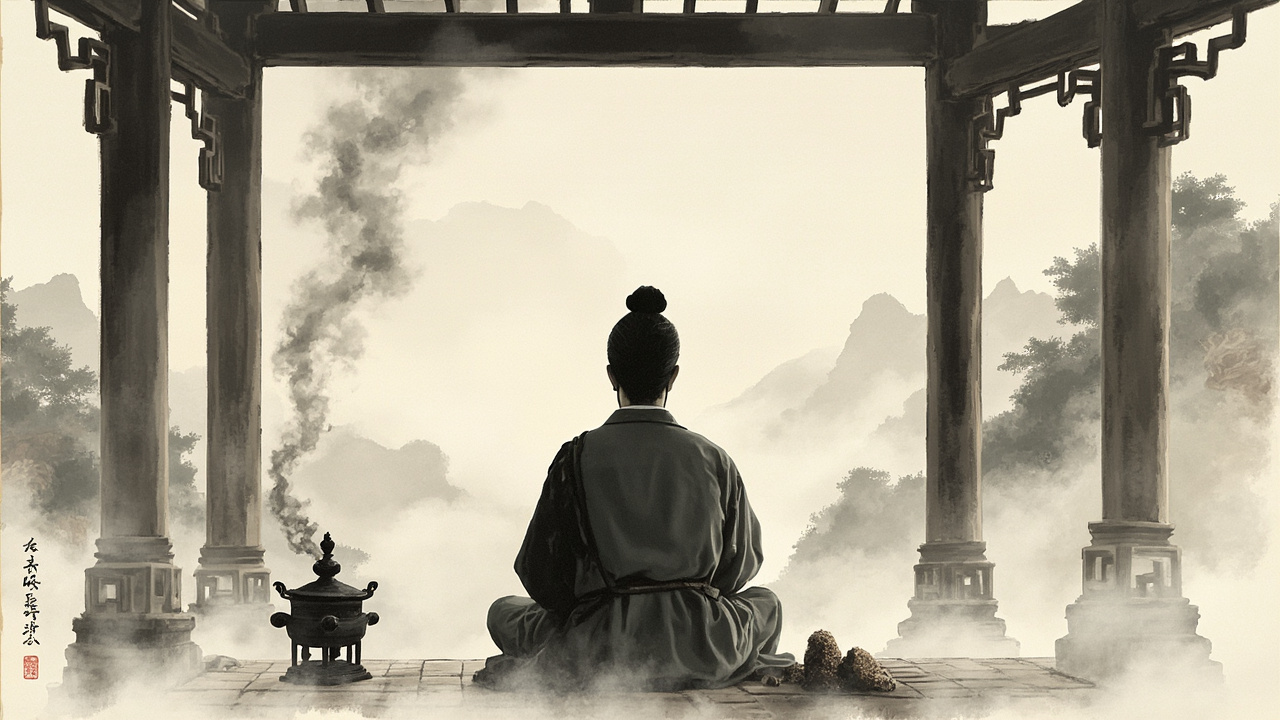
Xiangdao is not about smelling good. It is about cultivating awareness through the ritual of burning incense. In Chinese tradition, fragrance was never mere aesthetics—it was a path to self-knowledge, a technology for shaping consciousness, and a discipline as rigorous as any philosophical practice.
The Ancient Roots of Fragrant Governance
The word xiang (香) appears in Chinese texts dating back over three thousand years. In the Book of Documents (Shang Shu), the passage Zhi Zhi Xin Xiang (至治馨香) describes an ideally governed society as emanating a sweet fragrance—meaning that virtuous rule produces a pervasive moral influence, as natural and lasting as scent on the wind. This was not metaphor for its original audience. It was doctrine.
The Book of Rites (Li Ji), in the chapter Da Xue, states: Junzi Bi Shen Qi Du Ye (君子必慎其独也)—”The exemplary person must be watchful of themselves when alone.” Alone in the classical sense meant not merely physically unaccompanied, but spiritually unguarded. The incense burner became the instrument of that vigilance. Its smoke traced the air; its fragrance filled the stillness; its ashes recorded time passed in contemplation. To sit before it was to practice ren (仁)—humanity—through the body and breath.
Fragrance as a Technology of Attention
Before clock towers and before wristwatches, Chinese practitioners measured time with incense. The monk or scholar who lit a stick of sandalwood at dusk was not decorating a room. He was starting a timer. The burning of one zhi (炷)—a measure of incense roughly fifteen minutes in duration—became a unit of meditative practice. Burn enough sticks across enough seasons, and you develop a sensitivity to the passage of time that clockwork cannot replicate.
This is the practical philosophy of xiangdao: attention is trainable, and fragrance is the trainer. When the mind wanders, the incense reminds you. When the session ends, the room smells of what just happened there. You do not merely think your practice—you metabolize it.
The Taoist alchemists of the Tang and Song dynasties took this further. They classified incenses by their elemental correspondences—wood, fire, earth, metal, water—and used specific blends to address imbalances in the body’s qi. This was pharmacology as much as spirituality. The Confucian scholar sat with sandalwood to sharpen his moral clarity; the Taoist hermit burned realgar and musk to move stagnant energy through meridian pathways. Both were practicing xiangdao. They simply approached it from different doors of the same house.
The Confucian and Taoist Currents
Xiangdao draws from two deep rivers in Chinese thought. From Confucianism comes the emphasis on li (礼)—ritual propriety. The Confucian practitioner approaches incense as a tool of the Way, no different in principle from the gestures of bowing or the arrangement of vessels in an ancestral hall. The act of lighting incense, bowing, and offering is a total practice: physical posture, breath, intention, and environmental effect all aligned.
From Taoism comes the emphasis on wu wei (无为)—effortless action. The Taoist practitioner does not strain toward enlightenment. He burns incense and lets the smoke do what smoke does: rise, thin, vanish. The practice is less about self-improvement than about self-release. Fragrance becomes a medium through which the practitioner dissolves the boundary between inner awareness and outer world.
Neither current is complete without the other. A xiangdao practice stripped of li becomes indulgence; a practice stripped of wu wei becomes performance. The art lies in holding both—ceremonial discipline and spiritual openness—at once.
What Xiangdao Offers Today
Contemporary life offers no shortage of stimulation. We are overfed on information, exhausted by notification, and habituated to a kind of perpetual partial attention that erodes depth of thought and quality of presence. Xiangdao does not solve these problems directly. It does something more fundamental: it retrains the faculty of sustained awareness.
The regular practitioner of incense contemplation develops a quality of attention that is quiet, non-reactive, and steady. This is not mysticism. It is neurobiology. Focused attention on a single sensory object—particularly one that changes slowly over time like burning incense—exercises the prefrontal cortex and builds the habit of mental continuity. When you can sit with a single stick of incense for thirty minutes without reaching for your phone, something real has changed in your cognitive architecture.
Beyond the individual, xiangdao offers a philosophy of environmental influence. The Zhi Zhi Xin Xiang passage is as relevant now as it was in the Zhou dynasty: a household or community that cultivates clarity and virtue produces a social atmosphere that others can feel, even if they cannot explain it. Fragrance is the smallest and most elegant proof of this principle.
Conclusion
Xiangdao is a complete philosophical practice: ethical, contemplative, and practical. It asks nothing extraordinary of its practitioner except consistent presence. Light the incense. Watch the smoke. Return to your breath. The philosophy takes care of itself.
Frequently Asked Questions
Do I need to be Buddhist or Taoist to practice xiangdao?
No. Xiangdao is a philosophical framework that predates and transcends any single religious tradition. While it shares concepts with Buddhism and Taoism, its core practice—cultivating awareness through fragrance—is compatible with any contemplative tradition or none. Many practitioners today approach xiangdao as a secular mindfulness practice with roots in classical Chinese thought.
What type of incense should I use as a beginner?
Start with a single natural incense—pure sandalwood, agarwood (huaxiangk), or cedar—without added synthetic fragrances. Quality matters more than quantity. A little high-grade incense used with full attention is far more effective than a room filled with cheap stick incense burned distractedly. As your practice deepens, you will develop preferences informed by direct experience rather than marketing claims.
How long should an incense session last?
There is no fixed rule. Classical texts describe sessions of one to three zhi (sticks or coils), each roughly fifteen to twenty minutes, as a foundational unit. However, even five minutes of mindful incense burning can be a genuine practice if approached with full attention. The key is consistency, not duration. A daily ten-minute session will transform your attention more reliably than occasional hour-long rituals.
Is xiangdao about getting “high” or having spiritual experiences?
This is a common misconception. While certain rare incenses contain psychoactive compounds, the practice of xiangdao is not about alteration of consciousness. It is about clarity of consciousness. The goal is not to smell something extraordinary or to enter a trance. The goal is to sit in ordinary awareness, watch the smoke rise, and notice what happens in your own mind. Any experience that matters in xiangdao is the quiet accumulation of presence over time.
Can xiangdao be practiced in shared spaces or must I be alone?
Both modes are valid. Solo practice cultivates depth; shared practice cultivates atmosphere. Burning incense before an ancestral altar or in a family space is a form of xiangdao that engages the relational dimension—fragrance as a medium of connection with those present and those absent. The Da Xue instruction to be watchful when alone applies to the quality of inner attention, not to physical solitude.
What is the connection between xiangdao and Traditional Chinese Medicine?
TCM classifies aromatic substances by their properties—warming, moving, resolving, nourishing—and uses them in formulations to adjust the body’s qi and organ systems. Fragrant herbs like bai zhu (atractylodes), cang zhu (achenangelica), and xin yi hua (magnolia flower) appear in classical formulas. Xiangdao, in its medical dimension, operates on the principle that inhaled fragrance enters the lung meridian and influences emotional and physical states directly.
Related Articles: