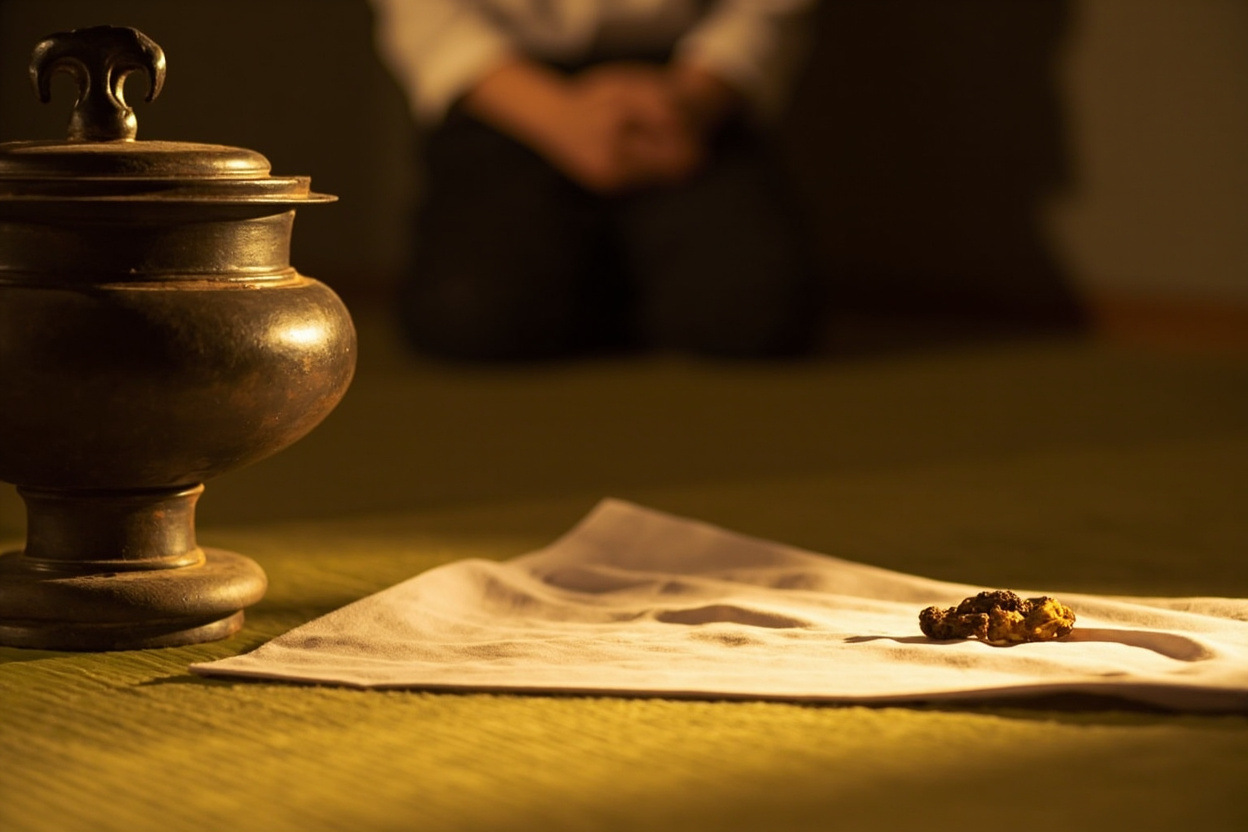
Two people burn incense. One is Chinese, burning a complex blended formula in a bronze censer. One is Japanese, holding a single piece of rare Vietnamese agarwood over a flame, then passing it to the next person. Both call it “香道.” Both are right. And that’s the interesting part.
Same Roots, Different Trees
The story starts with Buddhism arriving in Japan around 538 CE. The Buddhist monks brought incense with them. But incense didn’t stay in the temples. Over the next thousand years, it transformed into something distinctly Japanese—a practice called Kodo (香道), the Way of Fragrance.
The Japanese didn’t invent incense. They borrowed it from China, where incense had been part of scholar-official culture for centuries, especially during the Song Dynasty. But they did something interesting: they stripped it down, formalized it, and turned it into something with strict rituals and rules.
Meanwhile, in China, incense culture went the other direction—becoming more free-form, more about blending creativity, more integrated into daily life without rigid ceremony.
The result: two traditions that look almost opposite, yet share a common ancestor.
The Core Difference: Blending vs. Singularity
Walk into a Chinese incense practice, and you’ll likely encounterhexiang—blended incense. Sandalwood plus benzoin plus a touch of musk, mixed according to a classical formula. The craft is in combining multiple materials to create something none of them could achieve alone.
Walk into a Japanese Kodo ceremony, and you’ll encounter something different: one piece of wood. One smell. You focus on it completely for as long as it takes to understand what’s in front of you.
These aren’t better or worse. They’re different answers to the same question: what does it mean to appreciate fragrance?
The Six Countries, Five Tastes System
Here’s where Japanese Kodo gets serious: it has its own classification system, developed over centuries of refinement.
Six Countries (六国) classifies agarwood by origin:
- Kyara (伽羅) — Vietnam. The highest grade. The benchmark against which everything else is measured.
- Jinkun (沈香) — Indonesia, Malaysia. The standard market grade.
- Byakudan (白檀) — East Indian sandalwood. Different from agarwood, used in its own category.
- Shito (紫藤) — Japanese-produced. A curiosity more than a premium product.
- Chōji (丁子) — Clove. From Southeast Asia.
- Jinchō (沈丁) — A hybrid category.
Five Tastes (五味) classifies fragrance character:
- 甘 (Sweet/Am) — Sweet, mellow
- 酸 (Sour/San) — Slightly acidic
- 苦 (Bitter/Ku) — Sharp, bitter
- 辛 (Pungent/Shin) — Spicy, activating
- 咸 (Salty/Kan) — Dense, mineral
When a Kodo practitioner says “this is a sweet, sour, sixth-country Kyara,” everyone knows exactly what they mean. This precision took centuries to develop. It’s part of what makes Japanese Kodo distinctive—the rigor of the analytical framework.
The Group Games: Kodo’s Social Innovation
Here’s something uniquely Japanese: kumikō (組香)—group incense games.
Players receive multiple incense samples. They have to identify matches, recognize classic formulas, sometimes match scents to poems or classical references. The winner isn’t just someone with a good nose—they have to demonstrate knowledge of history, literature, and classical references.
Sound complicated? It is. But it transformed incense from a private practice into a social art form with rules, competition, and cultural depth. Japanese nobles spent hours playing these games, writing poetry about them, and passing the knowledge down through generations.
China never quite developed this equivalent. Chinese incense culture remained more intimate—personal practice, small gatherings, not formalized competition.
The Ritual Element
Japanese Kodo has rules for everything:
- How you enter the incense room
- How you receive the censer
- How you smell it (never directly—lift it to the side, let air carry the scent)
- How you pass it to the next person
- What you wear (formal kimono for serious sessions)
- How you discuss what you smell (specific vocabulary, specific forms)
Chinese incense practice has none of this rigidity. You burn what you want, when you want, however you want. The Chinese aesthetic is more like jazz—structured enough to be coherent, free enough to be expressive.
What Each Gets Right
What Chinese incense culture gets right:
Creativity and accessibility. Anyone can blend their own incense, develop their own aesthetic, share it with friends without ceremony. The entry barrier is low. The creative ceiling is high. It’s a living tradition that adapts.
What Japanese Kodo gets right:
Depth of analysis and preservation. The rigorous framework means knowledge gets passed down accurately. The ceremony creates psychological space—you’re forced to slow down and pay attention. The precision creates connoisseurship.
The Unexpected Connection
Here’s the twist: Japanese Kodo preserved techniques that China lost.
The indirect heating method—placing incense material on a mica plate or silver leaf above charcoal, so it heats without burning—was standard practice in Song Dynasty China. By the Ming Dynasty, Chinese practitioners had largely abandoned it for direct-burning stick incense. The method survived in Japan.
When modern Chinese incense enthusiasts want to learn indirect heating, some of them go to Japan to study. The student becomes the teacher becomes the student again. This is how cultural transmission works—wobbly, bidirectional, full of surprises.
If you’re exploring incense, try both. Burn a complex blended formula one evening—Chinese style, hexiang approach. The next evening, take a single good piece of sandalwood and sit with it for twenty minutes without doing anything else. Japanese style. Notice what you find.
That difference—between combination and singularity—is the whole story.