
The agarwood market confuses newcomers intentionally. Sellers use terms like “Grade A,” “Super Grade,” and “Ten-Year Aged” with no standardized meaning. One vendor’s Grade A is another’s Grade B. Without a universal grading standard, buyers need to understand the actual criteria that determine quality and price. This guide cuts through the noise.
Why Grading Matters
Agarwood grading exists for one reason: money. Higher grades command exponentially higher prices—a single gram of top-tier qinan can cost as much as a kilogram of standard Grade C wood. Understanding grading prevents overpaying for mediocre product and helps identify genuine premium when it appears.
The fundamental principle is simple: more resin, higher grade. Everything else—color, weight, fragrance intensity—flows from resin concentration. But measuring resin concentration directly requires laboratory equipment. Grading systems translate physical characteristics into quality estimates.
The Five-Tier Market Classification
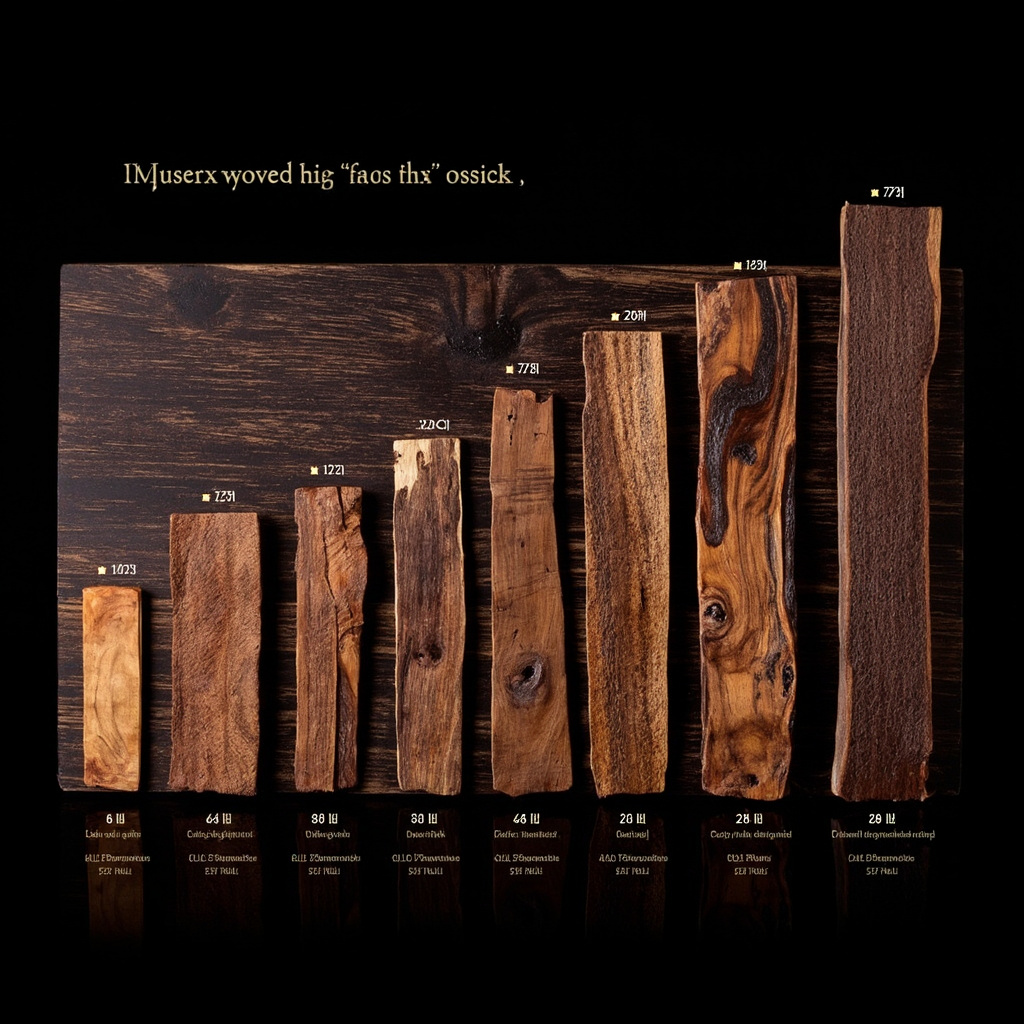
Most dealers use a five-tier system refined over centuries of Chinese commerce. This classification appears consistently across Vietnam, Hainan, and Indonesian markets, though regional variations in terminology exist.
Grade 1 (Jia): The entry level. Visible resin lines but sparse distribution. Weight noticeably higher than non-agarwood Aquilaria wood. When burned, produces clear agarwood fragrance but lacks depth and evolution. Suitable for beginners wanting authentic experience without investment.
Grade 2 (Yi): Improved resin distribution with visible veins and pockets. More complex fragrance than Grade 1, with discernible top notes. The standard for everyday burning in most households. Most commercial “沉香” labeled products fall here.
Grade 3 (Deng): Where quality becomes serious. Dense resin saturation throughout the wood structure. Fragrance opens quickly and evolves through distinct phases over 30-60 minutes. No artificial acceleration needed—the wood burns evenly at standard temperatures. The threshold for collector interest.
Grade 4 (Jia – 上): Premium category. Often called “shangjia” in the trade. Oil visibly weeping from cut surfaces. The wood sinks partially in water. Fragrance complexity matches qinan without quite reaching the same peak intensity. The sweet spot for serious practitioners balancing quality and budget.
Grade 5 (Qinan): The pinnacle. Not all grading systems include qinan as a grade—it represents a category rather than a quality tier within standard classification. Where Grade 4 represents exceptional chenxiang, qinan represents something fundamentally different in chemical composition and fragrance character.
The International Classification Problem
Japan, India, and the Middle East each use different grading systems incompatible with Chinese standards. Japanese kodo grades based on fragrance type rather than quality alone—some Japanese dealers prefer lighter-fragranced woods that Chinese systems would classify as Grade 2. Indian grading emphasizes spiritual efficacy over chemical quality, creating another divergence.
For international buyers, the practical approach is simple: use the grading system of the producing country. Vietnamese grading differs from Hainan grading. Trust the system native to your wood’s origin rather than imposing external standards.
Physical Tests for Grade Verification
Water test: Fill a container with room-temperature water. Place a small wood chip on the surface. High-grade agarwood (Grade 4+) partially sinks, oil being less dense than water. Full sinking suggests extremely high oil content. Floating without any penetration indicates Grade 1 at best.
Heat test: Apply a heated needle to an inconspicuous area. High-grade wood produces oil immediately as white smoke, accompanied by strong fragrance. Lower grades require more heat and longer exposure before releasing fragrance.
Weight test: Compare equal volumes of different grades. Higher resin concentration produces measurably heavier wood. This test requires experience—keep reference samples if possible.
How Dealers Mislead
The most common deception involves upgrading classification terminology. A dealer might describe Grade 2 wood as “Grade A” or “Premium Select,” using marketing language to obscure quality. Without understanding the five-tier system, buyers accept false descriptions.
Another manipulation involves origin inflation. Vietnamese wood sold as Hainan product commands premium pricing. Geographic origin significantly affects fragrance character—Vietnamese and Hainan agarwoods, while both genuine, differ noticeably to experienced practitioners. Misidentification may be intentional or simply ignorant.
Age claims are unverifiable and frequently fabricated. “Twenty-year aged” wood might be five years old with accelerated aging treatment. Genuine aged wood exists but represents a small fraction of the market. Price alone cannot confirm age claims.
FAQ
Is there a universal agarwood grading standard?
No. Chinese, Vietnamese, Japanese, and Indonesian systems differ substantially. Each has internal logic appropriate to its market but no international standard exists. Learn the grading system native to your wood’s origin.
What grade should a beginner start with?
Grade 2 or Grade 3. Grade 1 provides authentic experience but lacks the complexity that demonstrates why practitioners prefer higher grades. Starting at Grade 2-3 gives accurate impression without overpaying while you develop fragrance memory.
Can I trust dealer grading?
Partially. Reputable dealers provide accurate grading within their own system. The problem arises when different systems use overlapping terminology differently. Always verify physical characteristics yourself rather than accepting grading claims blindly.
Why does qinan sometimes appear as a grade rather than a separate category?
Some dealers classify qinan as “Grade 5” to fit the five-tier model. This is marketing convenience rather than botanical accuracy. Qinan differs from premium chenxiang in chemical composition, not just quality level. The distinction matters for serious practitioners.