
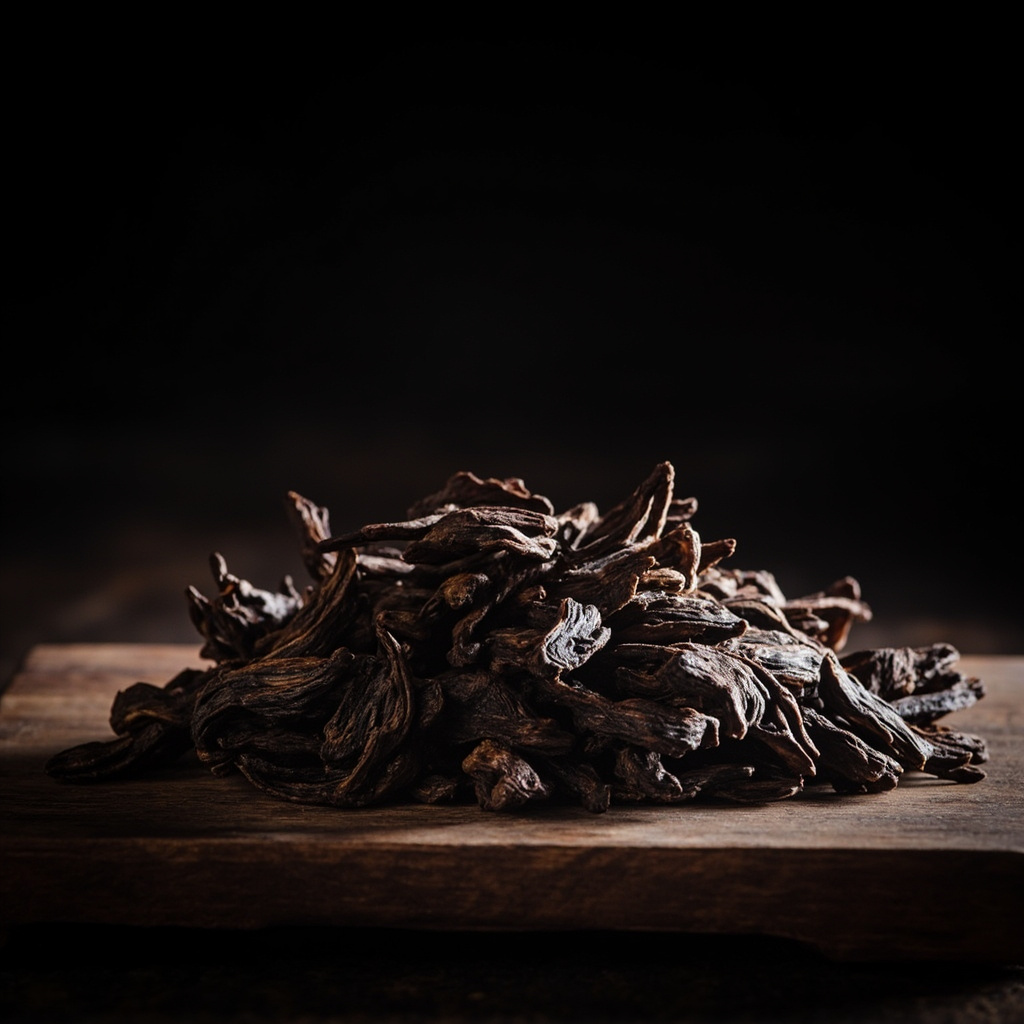
In the misty hills of Dongguan, where the Pearl River Delta meets the South China Sea, grows one of China’s most historically significant agarwoods. Guanxiang—literally “Guan [Dongguan] aromatic”—was for centuries the preferred incense of Cantonese scholars, Lingnan merchants, and Qing Dynasty court eunuchs who sourced it exclusively for the imperial palace. This is not the most expensive agarwood. But it might be the most culturally important.
The Origins of Guanxiang
Historical records of Guanxiang date back to the Han Dynasty (206 BCE – 220 CE). The Yuefu (《乐府》) documents reveal that Dongguan agarwood was already prized in the Han palace as Guangxiang—a distinct category separate from the Hainan and Vietnamese varieties available at the time.
What made Guanxiang distinctive was its terroir. The sandalwood family trees (Aquilaria sinensis) growing in the Dongguan hills developed resin in response to specific soil conditions: acidic volcanic red earth mixed withSEA salt carried by coastal winds. The resulting oil carried notes absent from other Chinese origins—a salt-brine sweetness underlying the woodsmoke that Cantonese practitioners recognized immediately.
As the Xiangpu (《香谱》), Chen Ji-Yu’s 12th century treatise, records: “莞香之妙,妙在海韵。燃之,有潮汐之气味,非他香所能仿。”—The marvel of Guanxiang lies in its sea character. When burned, it carries the breath of tide and waves. No other incense can replicate it.
Guanxiang in Cantonese Culture
For the literati of Guangdong, Guanxiang was not merely a luxury. It was a statement of identity. While scholars in Suzhou burned sandalwood imported from India and Yangzhou nobles favored Hainan’s finest qinan, the Cantonese merchant class and gentry developed their own refined tradition around this local treasure.
The Cantonese tea ceremony—”cha siu”—typically concluded with a short incense period. Unlike the formal Kyoto kodo, the Cantonese approach was intimate: three friends in a teahouse, a single burner passed between them, each taking turns to appreciate the fragrance. Guanxiang was the preferred choice because its subtler projection suited the smaller rooms of Cantonese teahouses rather than the grand halls of northern estates.
The decline began in the 1930s. Japanese occupation disrupted supply chains. The subsequent civil war and collectivization further damaged the remaining forests. By the 1980s, authentic old-growth Dongguan Guanxiang had become almost mythological—mentioned in old families’ stories but rarely encountered in practice.
Modern Guanxiang: Revival and Confusion
Today, the name “Guanxiang” appears extensively in Chinese e-commerce, typically applied to any agarwood from Guangdong or Guangxi provinces. This marketing usage has diluted the historical specificity of the term. True genetic Guanxiang trees from the original Dongguan groves survive in small numbers at the Hexiangyong Agricultural Museum and several private estates.
The revival efforts are genuine but face challenges. Young trees planted in the original growing regions take 15-20 years to produce harvestable resin. The flavor profile of these cultivated specimens differs noticeably from old-growth Guanxiang—less brine, more sweetness. Whether this represents acceptable evolution or regrettable degradation remains debated among connoisseurs.
How to Use Guanxiang
Guanxiang suits the same preparation methods as other Chinese agarwoods: indirect heating on mica plates at low temperature, or tiny shavings in a traditional charcoal furnace. The fragrance profile opens quickly—within 30 seconds of heating—making it forgiving for beginners who might burn hotter woods to destruction.
For meditation, Guanxiang creates what Cantonese practitioners call qingmei (清媚)—a clean, flirtatious clarity that elevates mood without drowsiness. It works particularly well in the afternoon, when the body’s energy naturally dips but the mind remains active.
How to Identify Authentic Guanxiang
The salt-brine note is the key identifier. Hold a heated chip near your nose—authentic Guanxiang carries an oceanic mineral quality absent from pure Hainan or Vietnamese varieties. The wood color tends toward dark grey-brown rather than the black-purple of high-grade Hainan qinan.
Price provides another signal. While old-growth Guanxiang from verified Dongguan sources commands premium pricing—comparable to mid-grade Vietnamese—recent cultivated production has flooded the market at lower price points. Ask specifically about village of origin and tree age before purchasing.
FAQ
Is Guanxiang the same as regular Guangdong agarwood?
No. True Guanxiang specifically refers to agarwood from the historical Dongguan growing region with documented provenance. General “Guangdong agarwood” may come from any province and lacks the distinctive salt-brine character.
Why is Guanxiang less famous than Hainan agarwood?
Geography and politics. Hainan island had better imperial connections and remained accessible through dynastic transitions. Guangdong’s coastal exposure made it vulnerable to trade disruptions. The Cantonese also never developed the formal incense ceremony traditions that preserved Hainan’s reputation nationally.
Can beginners start with Guanxiang?
Absolutely. Guanxiang’s forgiving heating requirements and quick fragrance release make it an excellent introductory agarwood. The price-to-quality ratio is favorable compared to rarer varieties where beginner mistakes cost more.
What does Guanxiang smell like?
Woodsmoke, dried fruit sweetness, and—crucially—a mineral salt note reminiscent of ocean air. The combination is subtler than Hainan’s dramatic range but distinctly Guangdong in character.