
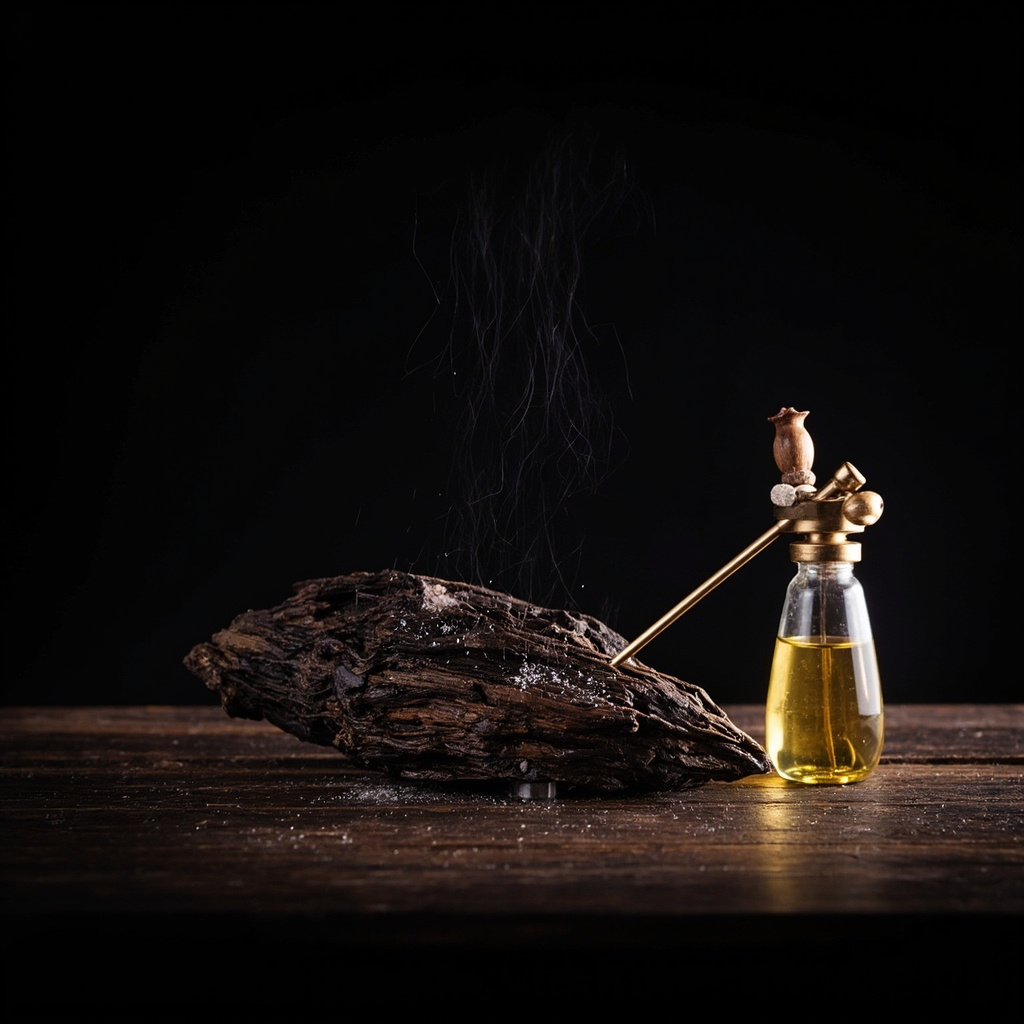
Deep in the tropical forests of Hainan Island, where monsoon rains soak ancient valleys and the air hangs thick with humidity, grows the most prized agarwood in the world. Hainan agarwood—known locally as qianjun (千家,军)—has been coveted by Chinese emperors, Daoist immortals, and connoisseurs for over two thousand years. It is not merely a fragrance. It is a geological miracle compressed into wood.
What Makes Hainan Agarwood Different
Most agarwood on the market today comes from Vietnam, Cambodia, or Indonesia. Good quality, certainly. But Hainan agarwood occupies its own category entirely. The island’s unique geological conditions—volcanic soil rich in minerals, high rainfall, and the specific altitude range of 400 to 800 meters—produce an oil of extraordinary complexity.
The key lies in the XIANG (香)—the fragrance compounds. Hainan agarwood typically contains higher concentrations of benzoin, vanillin, and the rare 2-phenylethyl acetate that gives it that unmistakable sweet-honey warmth beneath the woodsmoke. When you heat it, you do not just smell incense. You smell the island itself: humid valleys, moss-covered boulders, the sweetness of tropical fruit in the distance.
As the Beidou Qijing (《北斗七星神咒》) records: “军将下凡,化沉为香,千年不朽,万古流芳”—The general descends, transforms into agarwood, a thousand years without decay, glory through the ages.
The Three Grades of Hainan Agarwood
Not all Hainan agarwood is equal. Local dealers classify it into three tiers based on oil distribution and fragrance profile:
First Tier (Tianranjia): Oil distributed naturally throughout the wood with no human intervention. Extremely rare—perhaps one tree in ten thousand produces it. Fragrance: layered, evolving over hours of burning. Can retail for thousands of dollars per gram.
Second Tier (Yinhua): Oil concentrated in visible veins and pockets. The standard for serious collectors. Most “Hainan chenxiang” in premium shops falls here.
Third Tier (Jiaoyou): Oil concentrated through artificial inoculation—a process where farmers introduce fungi or chemicals to stress the tree. Effective, but the fragrance lacks the natural complexity. More bitter, less sweet.
How to Identify Authentic Hainan Agarwood
The market is flooded with counterfeit “Hainan” agarwood—often Vietnamese wood re-labeled. Here is how to spot genuine article:
Weight test: Soak the wood in water. Real Hainan agarwood with high oil content will partially float, oil being less dense than water. Fake wood sinks immediately.
The smell test: Scratch the surface lightly with a fingernail. Real Hainan agarwood releases fragrance immediately—even at room temperature. The smell has sweetness, not just bitterness.
The ash test: Burn a small sliver. Hainan agarwood ash is white or light grey and crumbles easily. Other origins produce dark, oily ash.
The price marker: If the price seems reasonable, it probably is not. Raw Hainan agarwood chips suitable for burning start at $30-50 per gram for mid-grade. Anything below that range warrants extreme skepticism.
How to Use Hainan Agarwood
Hainan agarwood responds best to indirect heating—the xiangdao way. Place a small chip on a mica plate over a charcoal ember at low temperature. The oil releases gradually, filling the room with fragrance that evolves over two to three hours.
Do not use electric burners. The sudden high heat burns off the volatile top notes before the deeper compounds can unfurl. The patient method is the correct method.
For meditation, light a single chip thirty minutes before your session. The fragrance creates what Daoist practitioners call qingjing (清静)—a clean stillness that settles the mind. Combined with proper posture, the effect is profound.
Where to Buy
The best source is directly from Hainan Island specialty shops, though this requires either travel or trusted contacts. Online, stick to dealers with verifiable Hainan sourcing—ideally those who can provide origin documentation from the specific village or forest district.
Avoid anything labeled simply “沉香” without origin specification. Hainan agarwood should always specify 海南沉香 or 海南奇楠. The difference in quality—and price—is substantial.
FAQ
Is Hainan agarwood worth the extra cost compared to Vietnamese?
For serious practitioners and collectors, yes. The fragrance complexity is measurably different—more floral top notes, sweeter base, longer lasting. For casual use, Vietnamese or Indonesian agarwood provides 80% of the experience at 20% of the cost.
Can I grow my own Hainan agarwood?
Technically yes, but the trees require 20-30 years of growth before producing usable resin. Commercial cultivation typically uses inoculation methods that reduce quality. The economics do not work for individual growers.
How should I store Hainan agarwood?
In an airtight container, away from sunlight and strong odors. The wood absorbs surrounding smells easily—a bag of spices next to your agarwood will compromise its fragrance within weeks.
What is the difference between Hainan qinan and ordinary Hainan chenxiang?
Qinan (奇楠) is the elite subcategory—older growth, higher oil content, fragrance that includes notes of nutmeg and cinnamon rather than just the standard honey-wood profile. Ordinary chenxiang is excellent; qinan is transcendent.