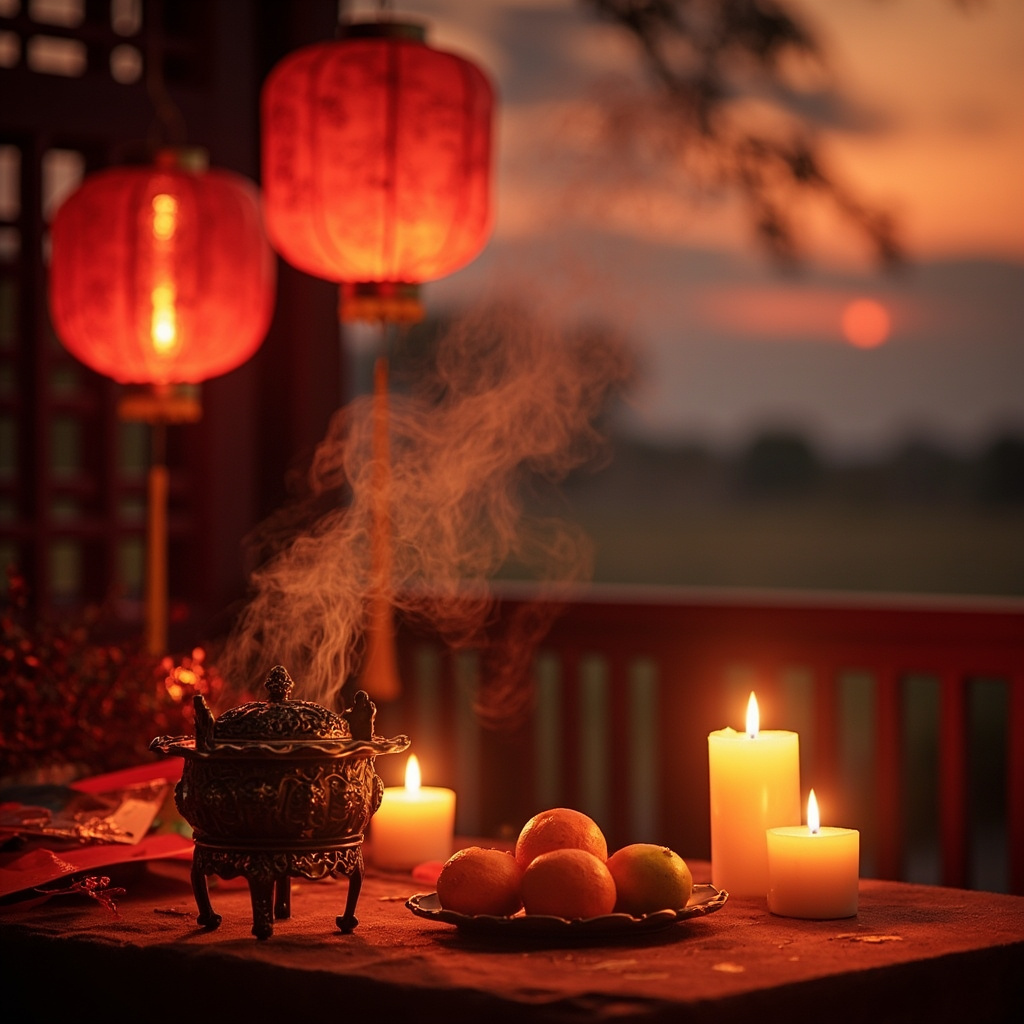
On the morning of Chinese New Year, before the first firecracker sounds, there is already smoke. Somewhere in every village and every city, an elder is lighting three sticks of incense at the family shrine. She bows. She murmurs something. Then she steps back and lets the fragrance speak.
This moment — this specific, repeatable, sacred-smelling moment — has been enacted in Chinese households for at least two thousand years. In Chinese culture, the sacred and the fragrant have always been inseparable. And nowhere is this more visible than in the major holidays.
Why Incense Is Central to Chinese Holidays
In Chinese cosmology, the major festivals are not just social occasions — they are liminal moments, when the boundary between the visible world and the invisible world thins. Incense is the bridge. The smoke carries prayers, gratitude, and remembrance upward. The fragrance marks the occasion as different from ordinary days.
This is not superstition. It is ritual technology — a system for directing attention, emotion, and intention toward specific moments and specific people (living and departed). The fragrance is the trigger, the marker, and the offering simultaneously.
Chinese New Year: Incense at the Doorstep of Heaven
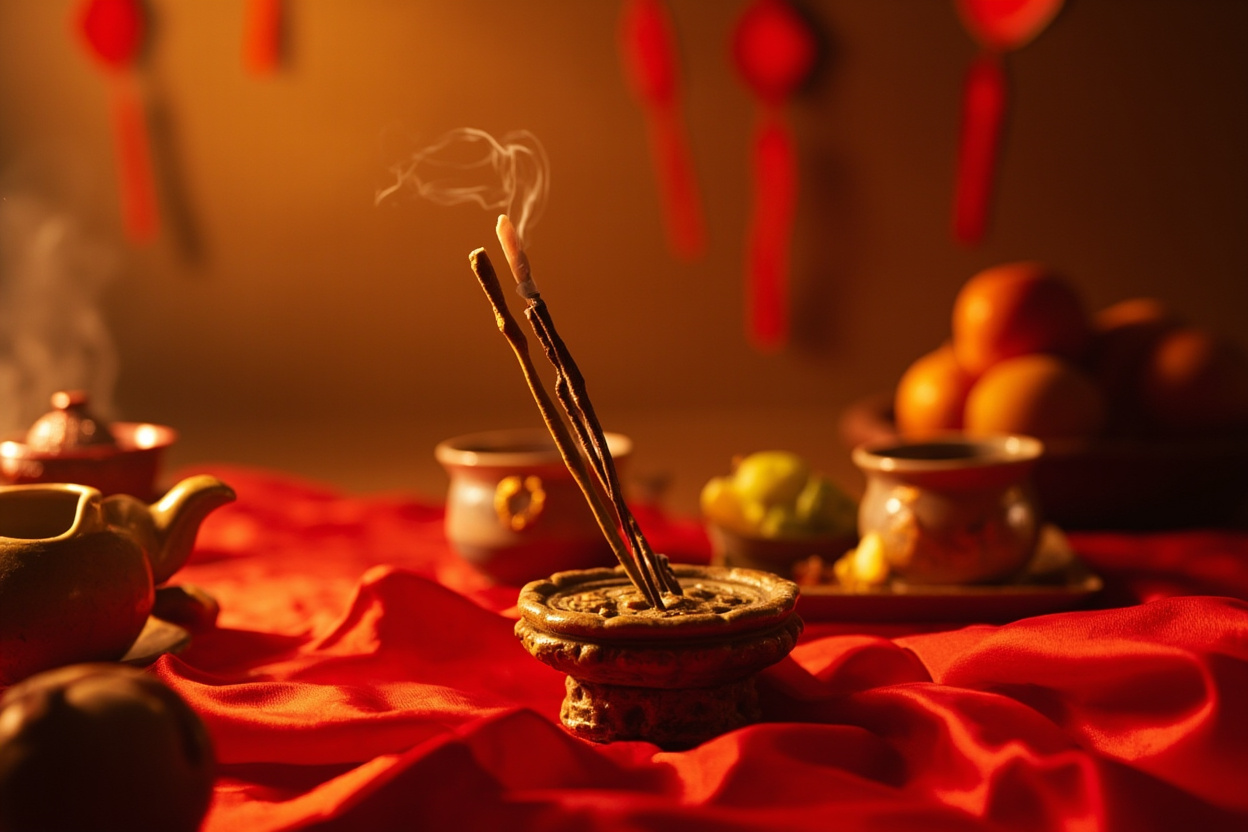
Chinese New Year is the single largest incense-burning occasion in the Chinese calendar. The entire festival is structured around incense: burning at the family shrine on New Year’s Eve, at the door on New Year’s morning, at the kitchen stove (灶神, the Kitchen God) in the days leading up to the festival, and at temples on the first day of the new year.
What to Burn and Where
- Family shrine / 祠堂: Use 檀香 (Tanxiang / Sandalwood) or a 沉香 (Chenxiang / Agarwood) blend — dignified, warm, honoring
- Temple visits on New Year’s Day: Follow the temple’s own incense protocol; most Chinese Buddhist temples provide standard temple incense sticks at the entrance
- Kitchen God ceremony (腊月二十三/二十四): Light 麻雀香 (Maqiao incense) or any sweet, smoky local blend — the Kitchen God is said to report on the household’s conduct, and the sweet smoke is an offering to soften his judgment
- Doorway incense on New Year’s morning: Two short sticks at the main entrance, representing welcome and protection for the year ahead
Etiquette for New Year Incense
- Always light three sticks — never one (one is for the deceased), never two (two is for ghosts)
- Insert the incense sticks into the ash with your right hand, or both hands if that feels more natural
- Bow three times after lighting, once for each of heaven, earth, and humanity
- If you visit a temple on New Year’s Day, buy fresh incense at the temple rather than bringing your own
Mid-Autumn Festival: Moonlight and Fragrance
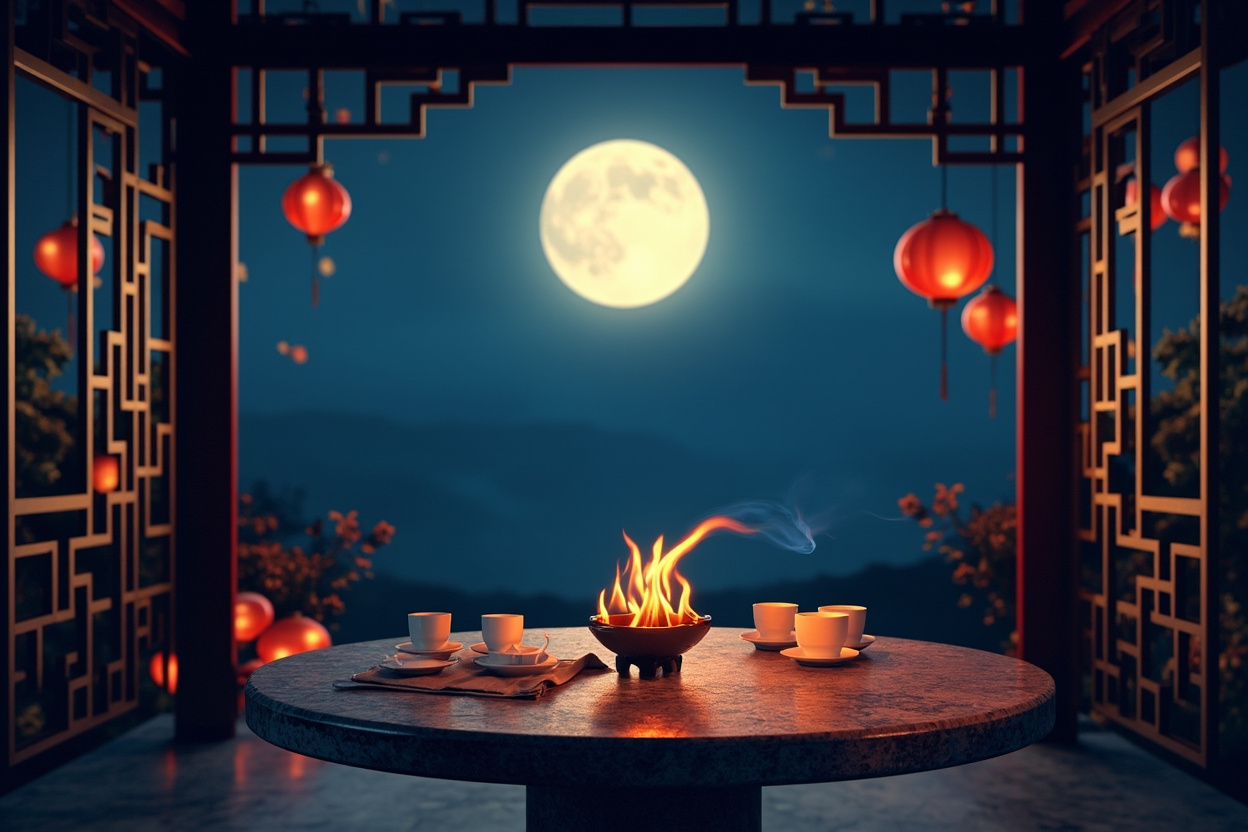
The Mid-Autumn Festival is the most poetic holiday in the Chinese calendar. It is celebrated on the 15th day of the 8th lunar month, when the moon is at its fullest and brightest. Families gather outdoors or by open windows to appreciate the moon, share mooncakes, and drink tea. Incense plays a supporting role here — not as an offering but as atmosphere.
Recommended Scents for Mid-Autumn
- 桂花 (Osmanthus / Guihua): the seasonal flower of autumn; its sweet, apricot-like fragrance pairs naturally with the season
- 鹅梨帐中香 (Eli Zhang Zhong): the legendary palace blend with sandalwood and pear — elegant, light, suitable for outdoor evening use
- Agarwood (沉香): a light grade, burned in an electric aroma tray outdoors — warm, woody, pairs with tea and moon
The key to Mid-Autumn incense is restraint. This is a night for moonlight and conversation, not for overwhelming fragrance. A small aroma lamp with a few drops of osmanthus oil, or one thin stick of light agarwood, is more than enough.
Qingming Festival: Honoring the Departed in Fresh Spring Air
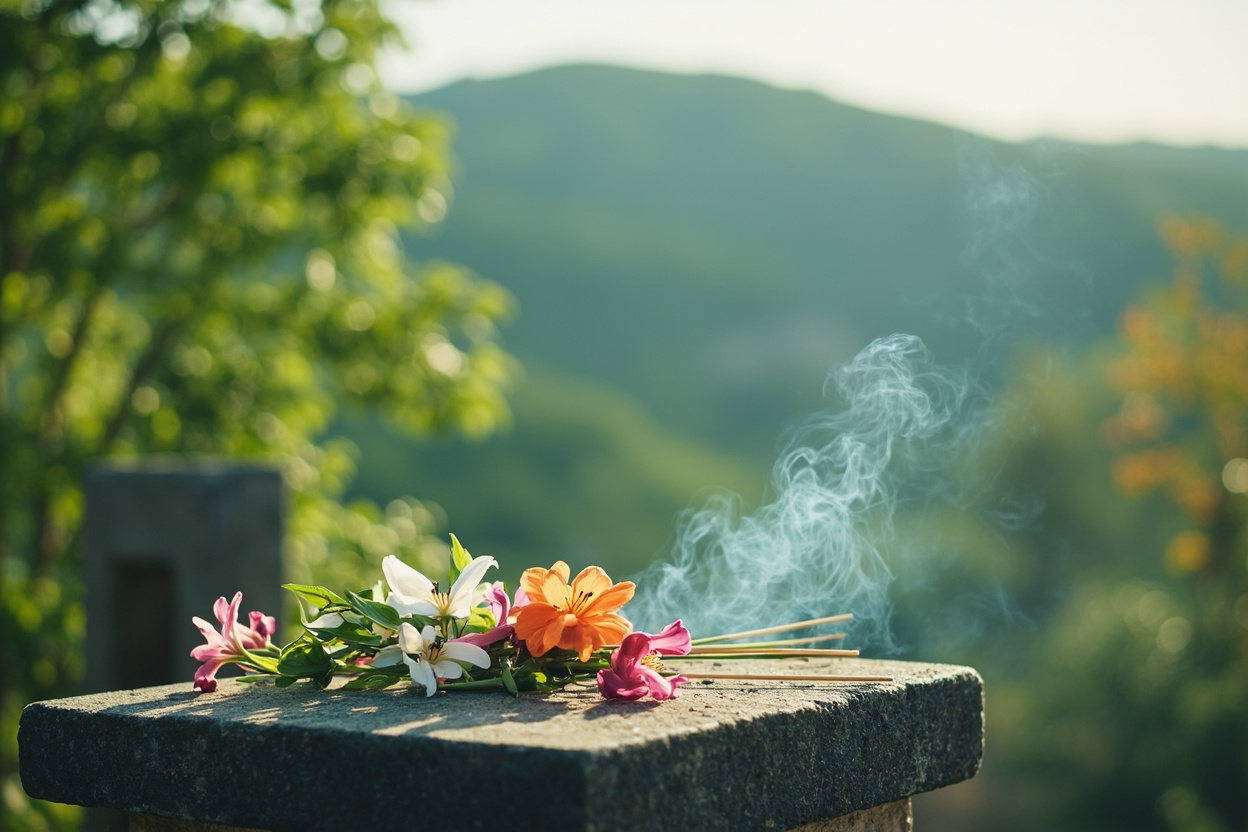
Qingming is Tomb-Sweeping Day, observed in early April when spring is fully arrived. Families visit ancestral gravesites to clean the area, offer food and drink, and burn incense and joss paper. Unlike the joyful atmosphere of Chinese New Year, Qingming carries a contemplative, tender quality — the spring is beautiful, but you are also thinking of those who are not here to see it.
Incense for Qingming
- Simple temple incense sticks (线香) are most appropriate at gravesites — they burn quickly, are inexpensive, and carry no pretense
- White chrysanthemum (白菊) or fresh spring flowers should accompany the incense as offerings
- Avoid heavy agarwood at gravesites — the setting calls for simplicity and respect, not luxury
- If visiting a temple instead of a gravesite, follow the temple’s guidelines for incense
Other Holidays Where Incense Matters
Dragon Boat Festival (端午节, 5th day of 5th lunar month)
Historically a day for驱邪 (expelling evil), this festival involves burning mugwort (艾草) and calamus (菖蒲) — both aromatic herbs hung at doorways and burned as incense. A simple bundle of dried mugwort smoldering in a bronze burner is traditional and easy to prepare at home.
Ghost Festival (中元节, 15th day of 7th lunar month)
One of the most incense-intensive festivals. Offerings are made to departed ancestors and wandering spirits. Families burn incense at doorways, windows, and roadsides to guide spirits safely. Heavy, smoky incense is traditionally used — the idea is to create a visible and fragrant path for the departed. Consider 合香 (He Xiang) blends with amber or benzoin for this occasion.
Winter Solstice (冬至)
Winter Solstice is considered one of the most important ancestral festivals in Chinese tradition. Families gather to honor ancestors before winter fully sets in. A warm, comforting fragrance like 沉香 (Chenxiang) or a ginger-and-cinnamon blend is appropriate for this solemn but nourishing occasion.
Important Safety Notes for Holiday Incense
- At outdoor events (tomb sweeping, temple fairs), use a wind-shielded burner to prevent uncontrolled fire spread
- Never burn incense near dry grass, leaves, or paper offerings in fire-prone areas
- Joss paper burning should always be done in a metal drum or designated burning area — never on the ground
- Indoor incense at family shrines should be limited to 2–3 sticks per session, with a window open for ventilation
- If you are attending a temple ceremony, follow all posted guidelines and respect temple-provided incense rather than bringing your own
- Keep children at a safe distance during joss paper and incense burning — the ember temperature of incense can cause serious burns
Frequently Asked Questions
Is it okay to burn incense on a balcony or outdoor area for a holiday if I live in an apartment?
Yes — and in fact, outdoor balconies are safer than indoor spaces for holiday incense burning. Just ensure the area is clear of any flammable materials, use a wind-protected burner, and avoid burning on windy days when embers could scatter. For apartment dwellers, an electric aroma lamp with a few drops of traditional incense oil is a respectful alternative.
What incense should I use for ancestor veneration specifically?
For ancestor veneration (祭祀), the most traditional choice is a simple sandalwood or cedar temple stick. This is not the occasion for rare or expensive沉香. What matters is intention and the act of offering, not the grade of incense. If you want something more refined, a sandalwood-cedar blend is a respectful step up.
Can non-Chinese people use incense during Chinese holidays?
Absolutely. The invitation to participate in Chinese holiday rituals is open to anyone who approaches with genuine respect. Burning incense at a Chinese temple, at a family altar you have been welcomed to, or even privately in your own home to honor the spirit of the season — these are all acts of cultural appreciation, not appropriation. The underlying principle is universal: use fragrance to mark the sacred in ordinary time.
What if I cannot burn incense due to health conditions or fire restrictions?
Cold diffusion with traditional incense oils is an excellent alternative. Osmanthus oil for Mid-Autumn, sandalwood oil for ancestral veneration, and cedar or pine oils for Dragon Boat Festival are all available and capture the spirit of the traditional scents without combustion. Reed diffusers or electric aroma lamps are completely fire-safe and suitable for indoor use in apartments or health-sensitive households.
The Chinese calendar is full of occasions that call for fragrance — not because fragrance is magical, but because it works. It marks time. It directs attention. It transforms an ordinary room into a place of intention. Explore our full collection to find the right incense for the next occasion on your calendar.