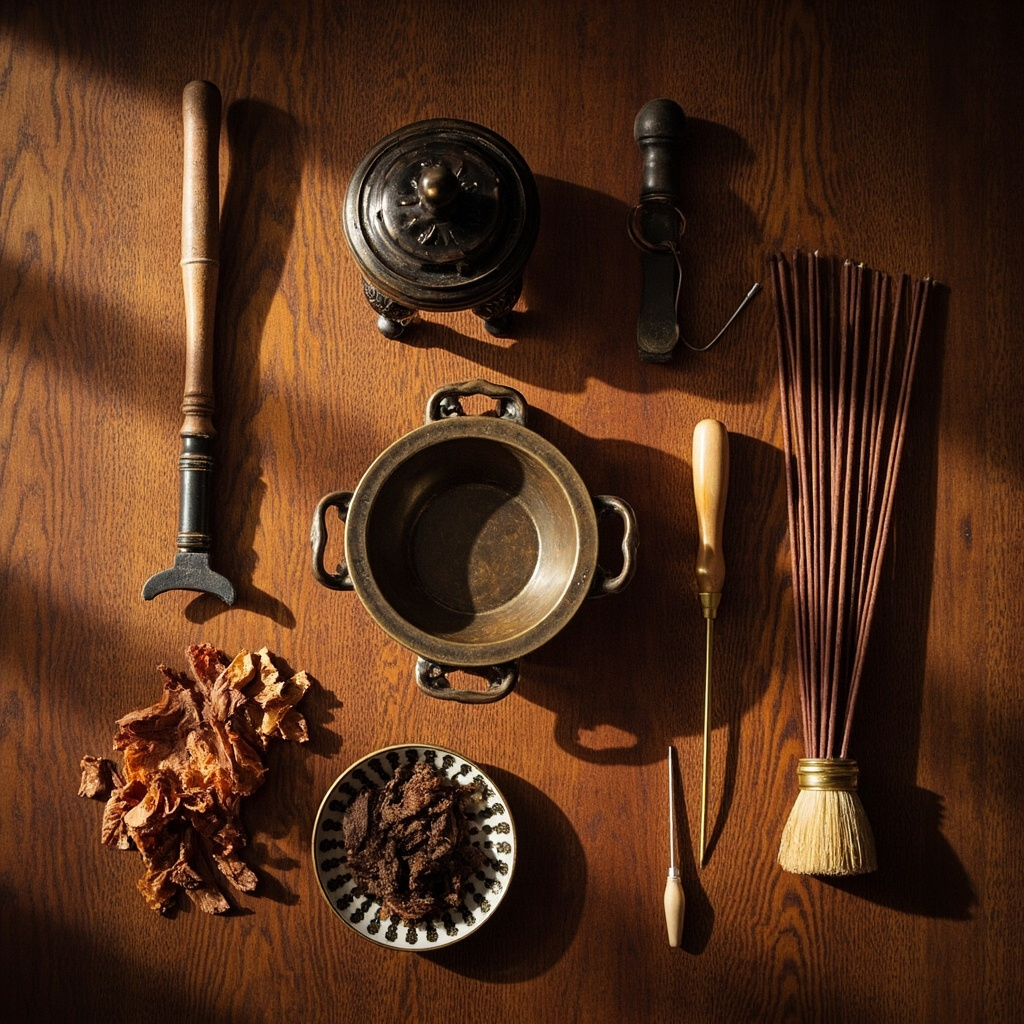
You have been burning incense for a while now. You have a favorite material, a method that works, a space that feels right. But every time you need to prepare a new session, you find yourself improvising – using a borrowed spoon, a mismatched bowl, a stick that will not stay upright. The tools of incense practice exist for a reason. They make the practice cleaner, more precise, and more meditative. This is a guide to every tool you actually need – and how to use each one properly.
The Incense Burner (香炉)
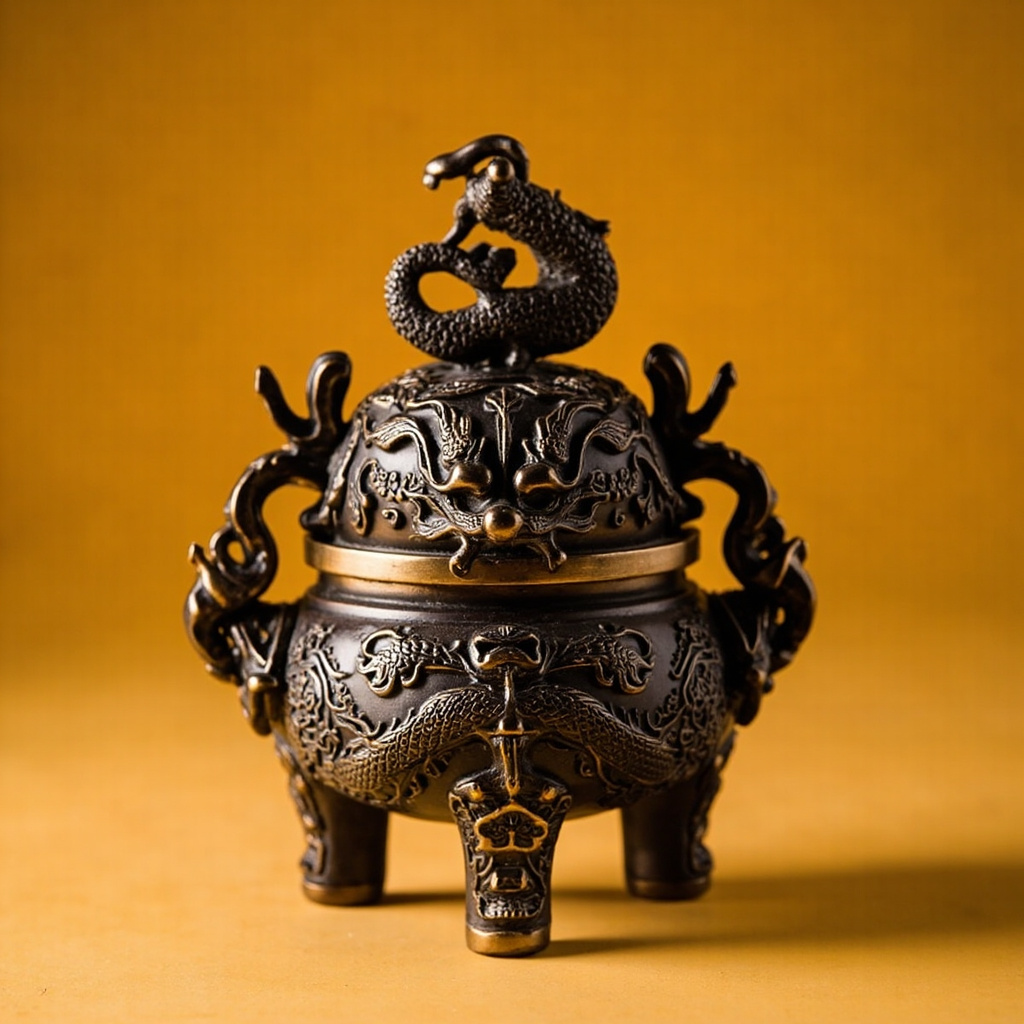
The burner is where everything happens. In Chinese incense practice, the burner is not merely a container – it is the center of the ritual space, placed at the center of a desk or table facing the practitioner. The quality of the burner matters less than its appropriateness for the type of incense you burn.
For direct burning (线香, 盘香): A wide-mouthed ceramic or brass bowl burner works best. The wide opening allows air circulation and prevents smoke from becoming too concentrated. A depth of 3-5 centimeters is ideal – deep enough to catch ash, shallow enough to allow airflow.
For indirect burning (隔火熏): A censer with a raised platform or mesh inside is essential. The charcoal burns below the platform, and the incense material sits above on the platform, heated by convection rather than direct flame. These censers are typically made of ceramic or bronze with a domed lid.
For cone incense: A tall, narrow burner with holes on the sides allows proper airflow for cone burning. Cone incense requires more oxygen than stick incense.
Charcoal (炭)
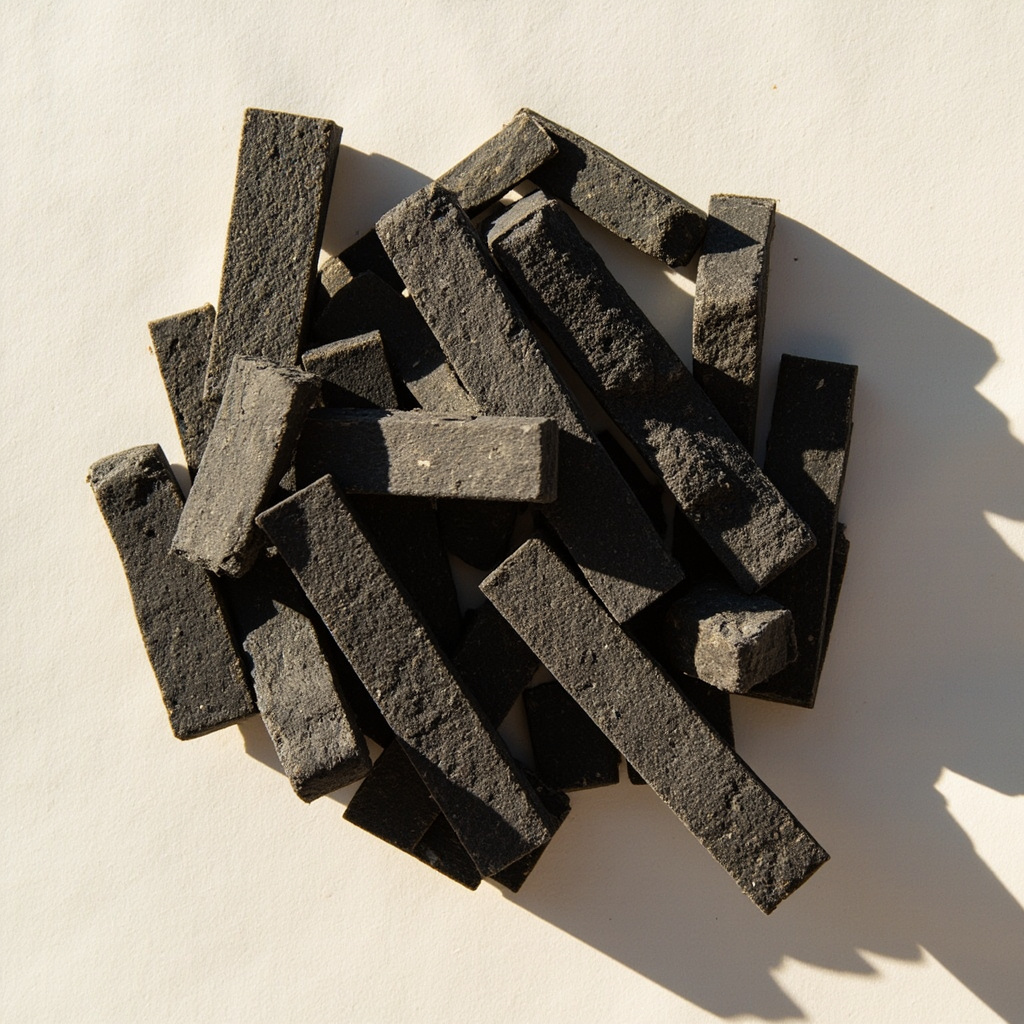
For indirect burning, the charcoal is the heat source. Not all charcoal is equal:
Incense charcoal (香炭): Specifically made for incense burning. Compressed into flat tablets, it lights easily, burns at the right temperature, and produces minimal odor. This is what serious practitioners use. Available from any Chinese pharmacy or specialty incense supplier.
Binchotan (白炭): A Japanese hardwood charcoal that burns cleaner and hotter than incense charcoal. Used in Japanese kodo practice and increasingly popular in Chinese-style practice. Significantly more expensive but preferred by serious practitioners.
Never use barbecue charcoal or other improvised heat sources – they produce odors that contaminate the incense fragrance and can release harmful compounds when burned.
Charcoal Tongs (炭钳)
Handling hot charcoal requires proper tongs. Incense charcoal tongs are typically made of brass or iron with bamboo handles, designed to grip the tablet charcoal securely without crushing it. The length (20-30 centimeters) keeps your hands safely away from the heat.
The technique: grip the charcoal at the edge, place it in the censer, adjust its position as needed. Practice placing and adjusting before lighting the charcoal – the motion should become familiar enough that you can do it without looking.
Ash and the Ash Layer
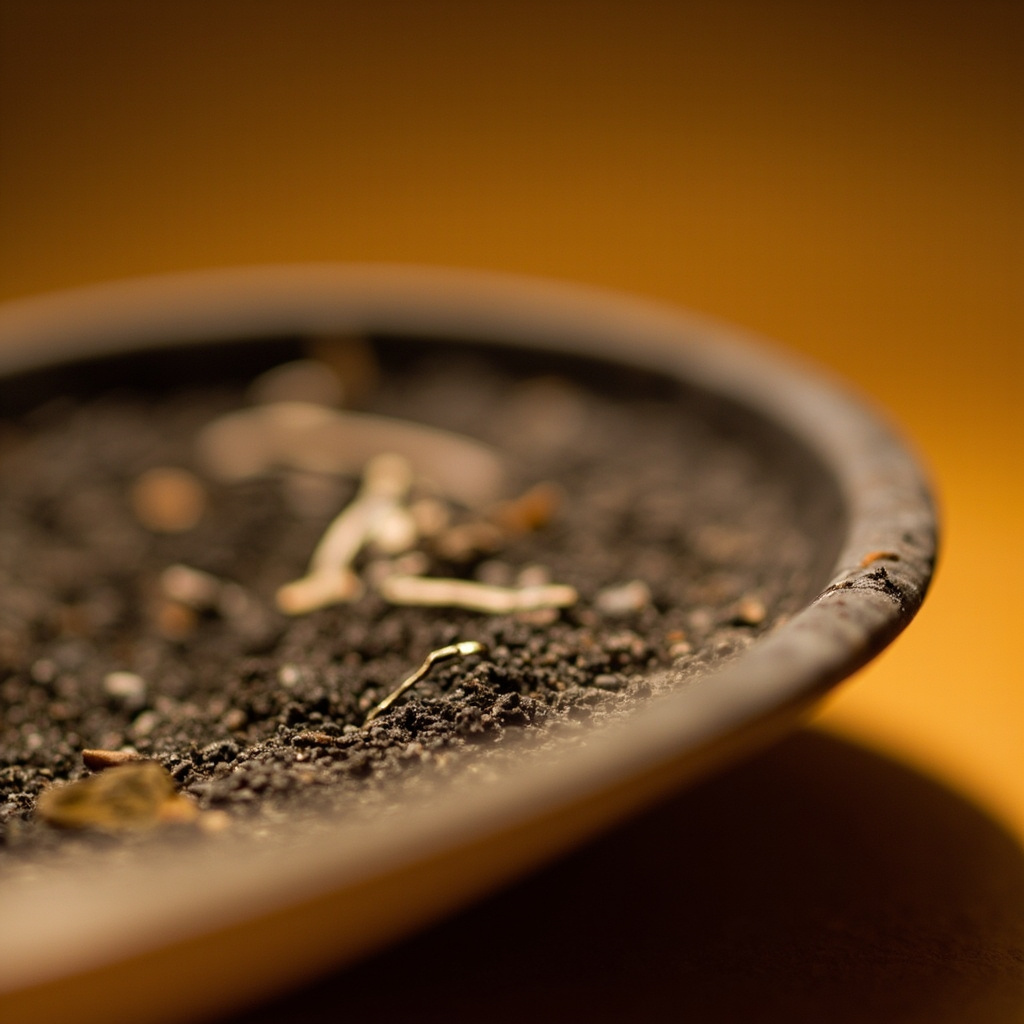
Ash management is one of the least-discussed but most practically important aspects of incense practice. The ash layer in your censer serves several functions:
Heat regulation: A layer of fine ash (2-3 millimeters) between the charcoal and the censer floor insulates the burner and regulates temperature. Without ash, the bottom of the censer can become too hot and crack over time.
Cleanliness: Ash catches falling ash from burning incense, making disposal easier and keeping the censer interior cleaner.
Aesthetics: The appearance of white ash in a dark ceramic censer is considered part of the ritual – the ash is not dirt but a material with its own quiet beauty.
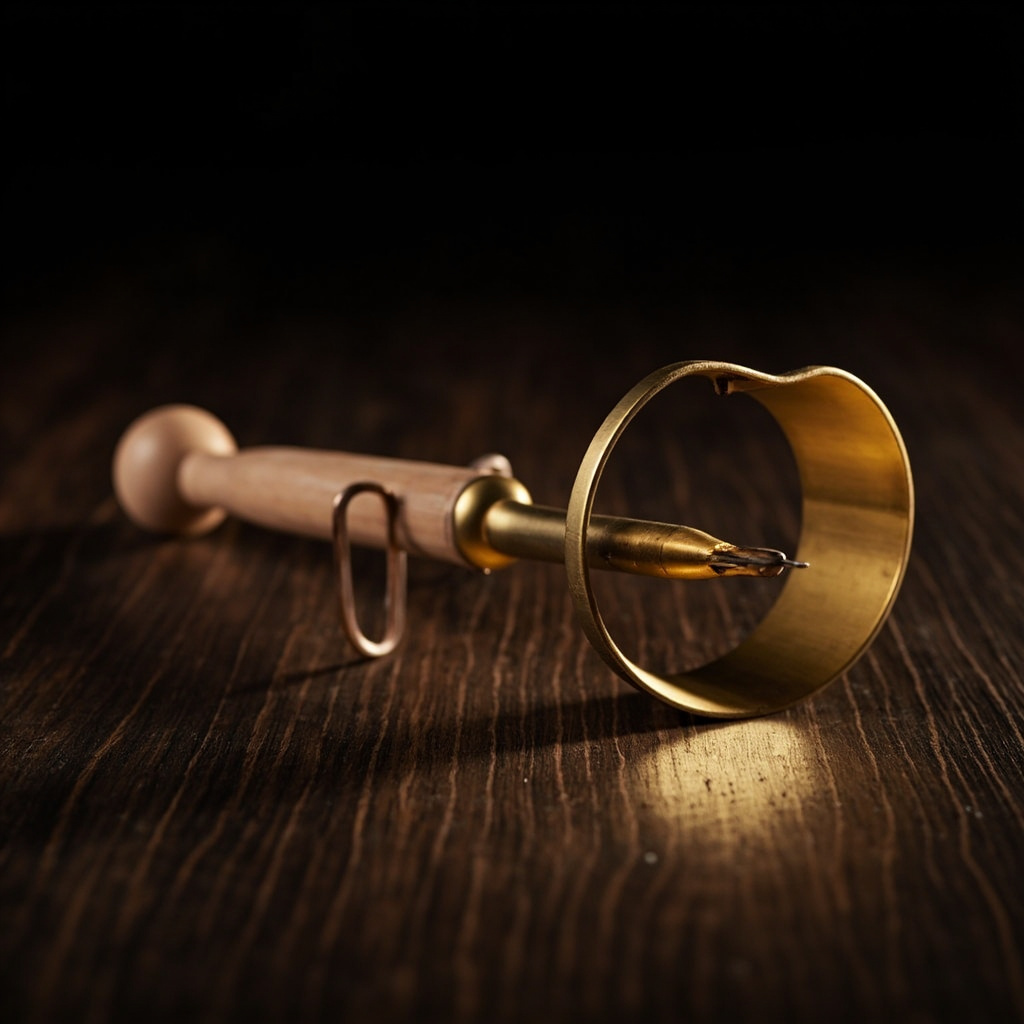
An ash rake (灰扒) or small brass brush is used to level and manage the ash layer. The rake has a bamboo handle and small metal head, designed for precise work.
The Ash Needle (香针) and Stick Guide
For stick incense, a thin needle (香针) about 20 centimeters long serves several purposes. The most practical: it is used to make a small pilot hole in the ash before inserting a stick, preventing the stick from slipping or wobbling. In traditional practice, the needle is also used to adjust the position of the incense in the censer without disturbing the ash layer.
The needle is typically made of bamboo, wood, or metal – any material that does not impart its own smell to the incense. Some practitioners use the needle simply as a guide and prefer to press the stick into the ash directly.
The Complete Tool Kit: What You Actually Need
You do not need everything at once. A functional starter kit requires just four items:
1. A ceramic bowl burner – Simple, inexpensive, effective for direct burning. A 10-centimeter diameter opening is versatile enough for most practice.
2. Incense charcoal – One container of tablet charcoal will last for months with regular use.
3. Charcoal tongs – Brass or iron, 20-25 centimeters long.
4. A 香针 needle or similar tool – Even a thin bamboo skewer works for positioning sticks.
As your practice deepens, you will naturally accumulate the additional items. The ash rake, additional burners for different methods, a proper storage box for materials – these are refinements, not necessities.
Tool Care and Maintenance
Proper care extends the life of your tools and maintains the purity of your incense practice:
Ceramic burners: Clean after each use by allowing ash to cool completely, then tapping out loose ash. Deep clean monthly by washing with water only – no soap, which can leave residue that affects fragrance. Dry completely before use.
Bronze burners: Polish occasionally with a soft cloth. Bronze develops a patina over time that many practitioners consider beautiful – this is normal and does not affect function.
Charcoal tongs: Wipe clean after each use. The brass versions develop a characteristic darkening with use that is normal.
Ash tools: Brush clean after each use. Bamboo tools can absorb fragrance over time – some practitioners consider this desirable, as the tools become part of the sensory environment of the practice space.
Where to Source Your Tools
Quality tools are more widely available than most beginners realize:
Chinese pharmacies: In areas with Chinese communities, traditional pharmacies often carry basic tools – burners, charcoal, tongs, needles. This is usually the most affordable option.
Specialty incense suppliers: Both online and physical stores specializing in incense supply quality tools alongside their incense materials. The advantage is matching – burners designed specifically for indirect burning, appropriate charcoal for the type of practice.
Japanese incense retailers: Japanese tools (shamansen, braziers, ash containers) are generally of very high quality and widely available online. Japanese and Chinese tools are largely interchangeable for most practices.
Antique markets: Old Chinese and Japanese burners can be found in antique markets – the craftsmanship of older pieces is generally superior to modern mass production. For functional rather than display use, minor damage (small chips, repaired cracks) does not affect performance.
Complete Tools FAQ
Can I use a regular candle as a heat source?
No. Candle flames are too hot and produce their own fragrance that contaminates the incense. For indirect burning, only charcoal (incense charcoal or binchotan) should be used. The temperature profile of burning charcoal is fundamentally different from candle flame – appropriate for heating incense materials without combustion.
How many burners do I need?
For most practitioners, one versatile burner is sufficient. If you practice multiple methods (direct burning, indirect burning, cone incense), you may want separate burners for each – or one adjustable censer with a removable platform. Some practitioners maintain multiple burners for aesthetic reasons – different burners for different spaces or moods.
What is the right price range for a beginner burner?
A functional ceramic bowl burner can be purchased for 50-100 yuan (8-15 USD) and will last for years with proper care. More expensive burners (brass, antique, specially commissioned) are for practitioners who want specific aesthetics or are making a long-term investment. Expensive does not mean better for burning purposes.