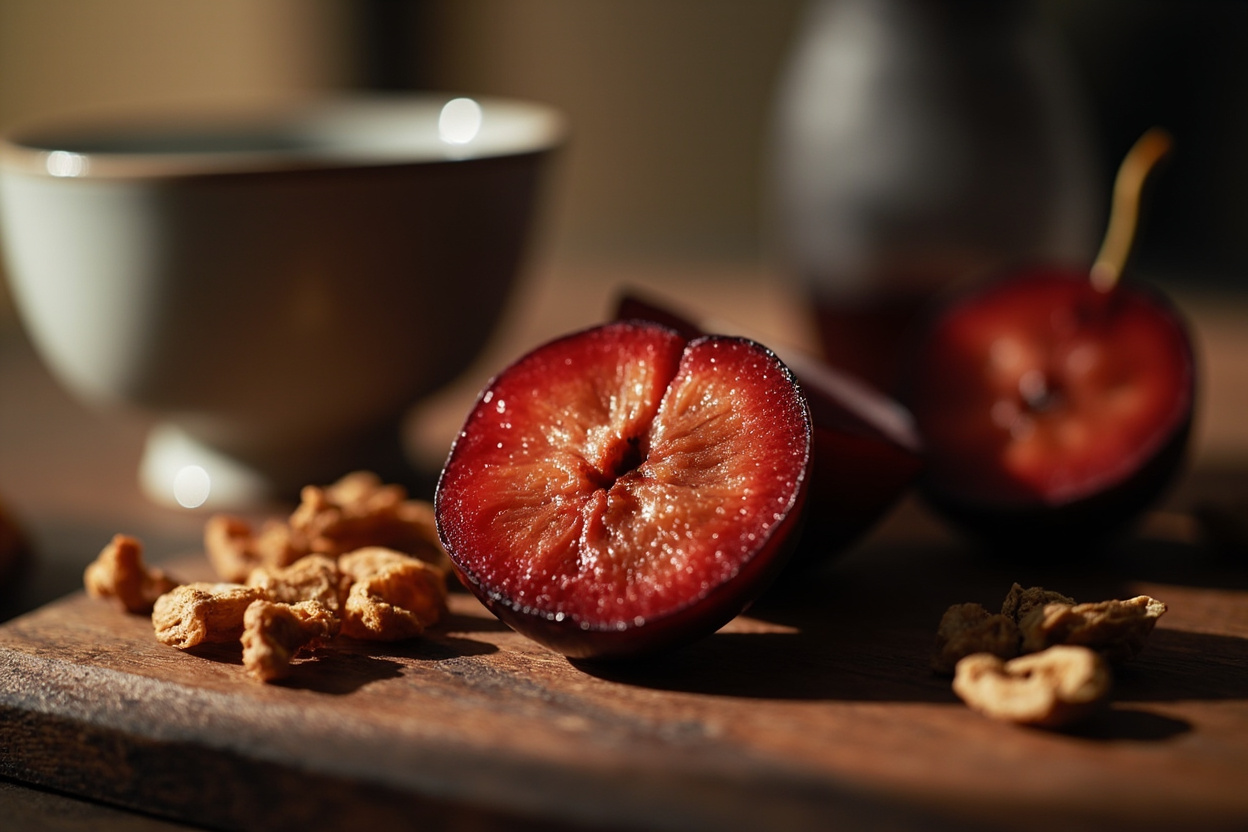
Here’s a recipe from the year 1100-something. It calls for plum wine, aged agarwood, and a specific waiting period. People who try to recreate it today report something unexpected: it actually works. And it smells like something that shouldn’t exist yet—a fragrance that feels modern, even though it was invented a thousand years ago.
This is the story of Fanhun Mei—Returning Soul Plum—the most famous incense formula from Song Dynasty China, and one that almost disappeared entirely.
Where the Recipe Comes From
The formula appears in Hong Chu’s Xiang Pu (香谱), compiled sometime in the early 1100s. Hong Chu was a Song Dynasty scholar who passed the imperial examinations in 1094, served as an official, got caught up in political upheaval, was exiled to an island, and died there.
But before all that happened, he collected everything he could find about incense—formulas, anecdotes, material descriptions, trade information—and organized it into the first comprehensive Chinese treatise on incense. Xiang Pu was the result.
The formula he recorded wasn’t his own invention. It was circulating in literati circles—passed between scholar-poets who burned incense while they wrote, traded formulas as casually as they traded poems. Fanhun Mei was one of the popular ones.
What the Original Says
The original recipe, as Hong Chu recorded it, goes roughly like this:
“取海南沉香,碎如豆粒,浸以青梅酒,密封瓷罐,埋土中一月,取出焚烧。”
Translation: Take Hainan agarwood, break into bean-sized pieces, soak in green plum wine, seal in a porcelain jar, bury in earth for one month, remove and burn.
That’s it. That’s the whole recipe. Six steps. No precise measurements, no complicated procedure, no special equipment needed.
The simplicity is the point. This wasn’t palace luxury—this was something a scholar with modest resources could actually make.
Why Plum Wine?
The choice of青梅酒—green plum wine—is deliberate and clever.
青梅 (green plum) has a distinctive sour-sweet fragrance that’s light and fresh. In TCM theory, it’s considered “cooling”—good for clearing excess heat from the body. When you soak agarwood in it, two things happen:
- The alcohol extracts the volatile aromatic compounds from the agarwood
- The plum’s own fragrance chemicals infuse into the wood
- The month of burial allows slow, deep penetration—the wine carries molecules into the wood’s cell structure
Modern chemists call this maceration. The Song Dynasty called it experience. The result: agarwood that carries plum notes in a way you can’t achieve by simply mixing the two.
What It Actually Smells Like
People who recreate the formula today consistently report similar findings:
- The opening scent is unmistakably plum—bright, sour-sweet, slightly tart
- As it develops, the base of aged agarwood emerges—deep, resinous, complex
- The combination reads as surprisingly modern: something between a fruit chypre and a woody oriental
- There’s a “coolness” to the scent that separates it from regular agarwood
The last point matches what TCM would predict—青梅 is a “cooling” ingredient, and that thermal quality translates into the sensory experience. The scent doesn’t sit heavily; it has lift.
Why It Almost Disappeared
If this formula was so good, why did it get lost?
Three reasons:
The Mongol invasion. The Song Dynasty ended in 1279 when the Mongols conquered China. The scholar-official class that kept literati incense culture alive was disrupted—some killed, some fled, most simply lost the institutional support that let them spend decades on perfume hobbies.
The shift to stick incense. By the Ming Dynasty, direct-burning stick incense had become dominant. The maceration and burial techniques that made Fanhun Mei special required more time and attention than most people were willing to give.
Better-preserved alternatives. Some formulas survived in temple contexts, in folk practices, in Japanese Kodo (which preserved indirect heating techniques). Fanhun Mei was more fragile—it required specific materials (Hainan agarwood, genuine青梅酒) and patience. When those became harder to source, the formula faded.
How to Actually Make It
Here’s the modern recreation process:
- Start with quality agarwood — This isn’t a recipe where cheap material will work. You need decent Hainan or Vietnamese agarwood with good resin content. If your base material smells one-dimensional, the final product will too.
- Break it carefully — “豆粒” means bean-sized. Don’t powder it—leave some texture. More surface area without losing structural integrity.
- Use real青梅酒 — If you can find it: Chinese青梅酒 or Japaneseumeshu. The alcohol should be around 15-20% for good extraction. Regular wine won’t give you the right character.
- Seal tight — Porcelain is traditional. Any airtight container works. The point is preventing evaporation.
- Wait — One month minimum. Some practitioners report better results with two to three months. Longer isn’t necessarily better past a point—the wood saturates.
- Remove and dry — Pull the wood out, let it dry briefly (not completely—the wine residue is part of the character), then burn on charcoal.
What You’re Actually Doing
You’re making perfume in the year 1100 style. The alcohol extracts aromatic compounds from the wood—the same principle used in modern perfumery for maceration and enfleurage. The plum isn’t just flavoring; it’s a solvent that carries certain molecules more effectively than straight ethanol would.
When you burn the finished product, you’re burning a chemically modified version of agarwood—not agarwood with plum smell added, but something where the plum and agarwood have become a single integrated compound.
This is sophisticated chemistry. The Song Dynasty did it through observation and experimentation without knowing the mechanism. We do it knowing the mechanism. Either way, it works.
Why Bother
If you can just buy incense, why make your own?
Because the process changes what you smell. When you’ve madeFanhun Mei yourself—when you’ve waited the month, opened the jar, smelled the transformation—you perceive it differently. The intellectual understanding becomes sensory knowledge. You know what “plum-infused agarwood” actually means because you made it.
That’s what the Song Dynasty literati understood. Making incense wasn’t a means to an end—it was part of the practice. The making was the meditation.
If you try this recipe, pay attention to what happens at each step. The soaking. The waiting. The opening. Each stage teaches you something about the materials. That’s the real point—not the destination, but the time you spend getting there.