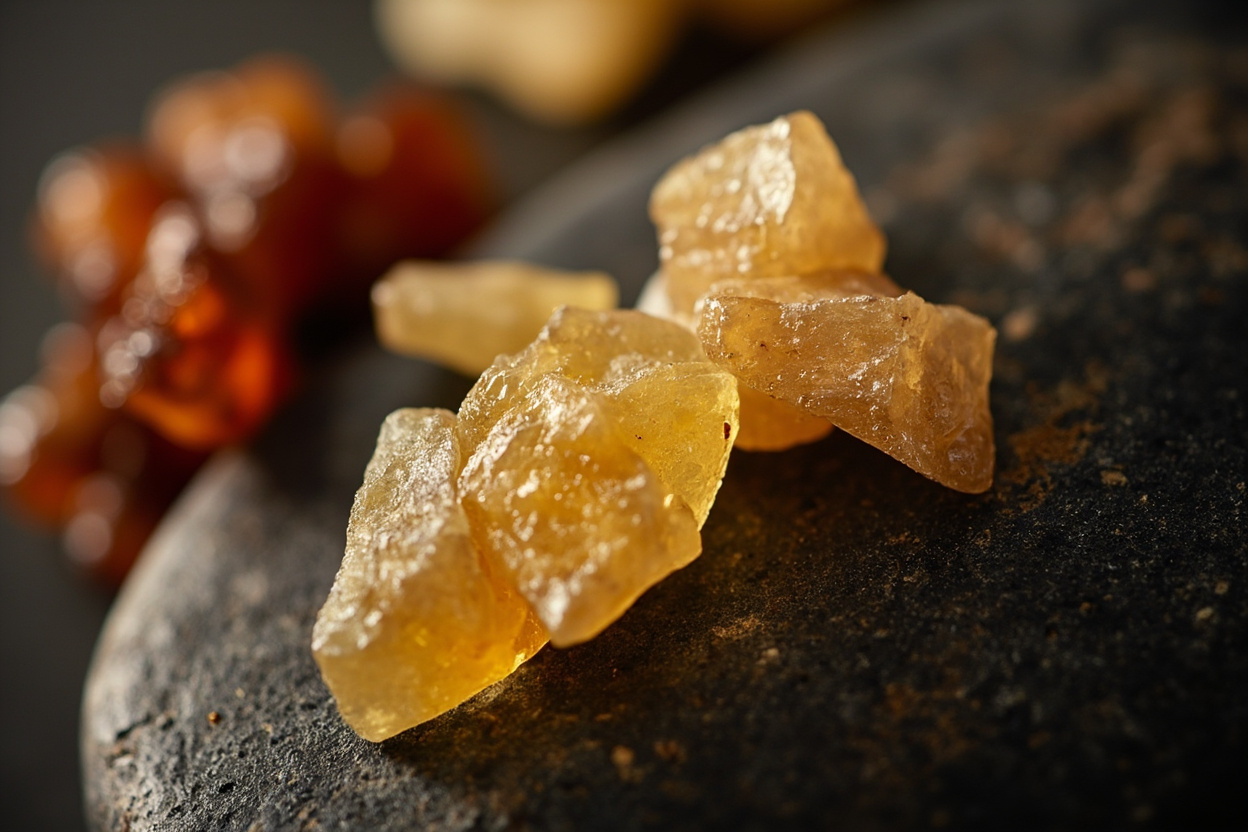
Three kings brought gifts to Bethlehem. Gold, frankincense, and myrrh. Of the three, frankincense and myrrh were the exotic ones — imported resins from the Horn of Africa, traded thousands of miles to reach the Mediterranean world. They’ve been in continuous use for over 5,000 years. That’s not incense history. That’s civilization.
What Are Frankincense and Myrrh?
Both are aromatic resins — not woods, not leaves, not flowers. Resins are the trees’ defense systems. When you wound a Boswellia tree (for frankincense) or a Commiphora tree (for myrrh), the tree bleeds a milky gum that hardens into the resin we burn.
This is different from most Chinese incense materials. Sandalwood is wood. Agarwood is infected heartwood. But frankincense and myrrh are gum-resins — similar in concept to the rosin that violin bows use.
Frankincense: The Classic Resin
Frankincense comes from trees of the genus Boswellia, primarily grown in the Horn of Africa (Somalia, Ethiopia) and the Arabian Peninsula. The trees start producing resin when they’re about 8-10 years old. Harvesters tap them two to three times per year, and the later taps — when the tree has had more time to concentrate aromatic compounds — produce the highest quality.
The word “frankincense” comes from Old French “franc encens” — meaning “true incense” or “high-quality incense.” The English word entered the language in the 13th century, but the product had been traded since ancient Egyptian times.
What it smells like: When burned, frankincense produces a light, clean, slightly citrusy smoke. It’s not as complex as agarwood, but it has a clarity and brightness that some find more meditative. The smoke from high-quality Omani frankincense is noticeably sweeter and more refined than African grades.
Grades: The quality depends on the Boswellia species, the region, and the harvest time. The best frankincense produces large, milky-white tears with high transparency. Lower grades are more brown and opaque. If you’re buying, look for the whitest, most translucent tears you can find.
Myrrh: The Dark Counterpart
Myrrh comes from trees of the genus Commiphora — related to frankincense but producing a very different resin. Where frankincense is light and sweet, myrrh is dark, earthy, and somewhat bitter.
The word “myrrh” comes from Hebrew “mor” — meaning “bitter.” The etymology is accurate. Myrrh’s aroma is indeed more bitter and less immediately pleasant than frankincense. But that’s not a weakness. In blending, myrrh adds depth and earthiness that frankincense alone can’t provide.
Myrrh has a longer history in Western and Middle Eastern traditions than in Chinese practice. It appears prominently in Egyptian embalming (as a preservative), in Hebrew Bible rituals, and in early Christian incense. In Chinese TCM, myrrh (Mo Yao) is used for its blood-moving properties — but as an incense material, it’s more associated with Western traditions.
What it smells like: Dark, earthy, slightly medicinal. When burned alone, it can be intense — even harsh. In blends, it adds a grounding element that balances lighter materials. Think of it as the bass note in a fragrance.
How to Use Them in Incense
Both resins require indirect burning — they don’t burn well on a stick. The standard method:
- Use a charcoal disc or a专门的熏香炉 (xun xiang lu)
- Place a small piece of resin on a metal screen above the heat
- The resin will melt, bubble slightly, and release fragrant smoke
- A little goes a long way — 0.5-1 gram per session is enough
Blending with Chinese Materials
Here’s where it gets interesting. In traditional Western incense, frankincense and myrrh are often burned together (as in liturgical settings). In Chinese Xiangdao, they can be integrated into hexiang blends:
Formula idea: 60% sandalwood powder, 25% frankincense tears (crushed), 10% dragon well benzoin, 5% myrrh resin. The frankincense adds brightness, the myrrh adds earthiness, the sandalwood provides body. Burn on charcoal.
Where to Buy
High-quality frankincense and myrrh are widely available online. Look for:
- Somali frankincense (Hojari grade = highest quality)
- Ethiopian frankincense (also excellent, slightly different character)
- Yemeni myrrh
- Somali myrrh (Metagita trade name)
Start with small quantities (25-50 grams). Both materials last a long time — you only need a little per session.
The Historical Weight
When you burn frankincense, you’re using a material that was traded along desert caravan routes before recorded history. It was burned in the temples of ancient Egypt, mentioned in the Dead Sea Scrolls, used in Roman religious ceremonies, and traded across the Sahara to sub-Saharan Africa.
That’s not just marketing copy. The archaeological record confirms frankincense was already in widespread use by 3000 BCE. Whatever you believe about its spiritual significance, you’re connecting to something genuinely ancient when you burn it.