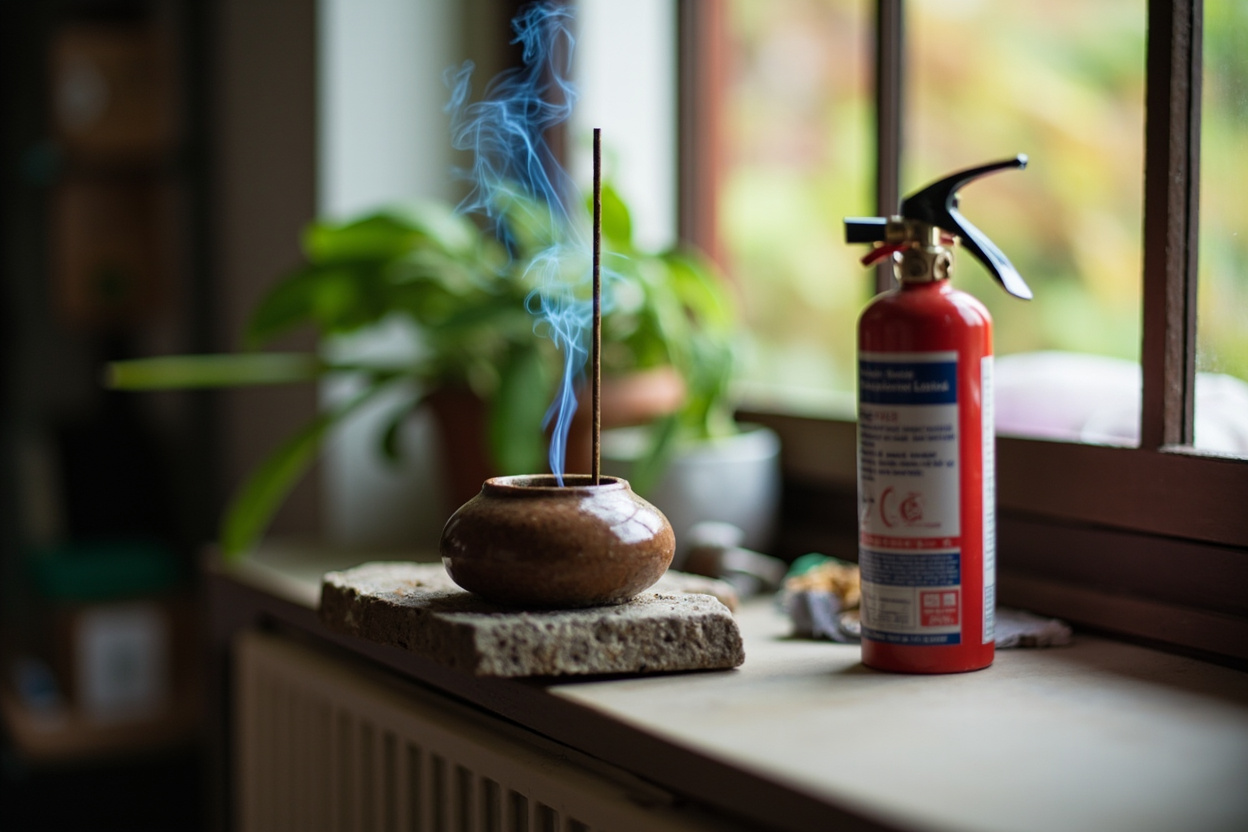
A charcoal starts to glow. You light your stick. Five minutes later you leave the room. The stick falls over unnoticed. Your apartment building has a fire alarm problem.
Incense is safe when used properly. Here’s how to use it properly.
The Hard Rules (Non-Negotiable)
- Never leave burning incense unattended. Not for 5 minutes. Not for 1 minute. If you leave the room, extinguish it first.
- Keep away from anything flammable. Curtains, paper, bedding, clothing. The tip burns at 400-500°C. That’s not a joke.
- Use a proper holder with a wide base. It should not tip over if bumped slightly. Sand-filled bases are best.
- Place it on a non-flammable surface. Stone, ceramic, metal. Not wood, not plastic, not your laptop.
- Keep away from pets and children. Cats especially seem fascinated by smoke and will knock things over.
The Setup Before You Light
- Check the room. Close windows and doors that create drafts. Open one window partially for ventilation. You want still air but not a sealed room.
- Check the holder. Is it stable? Is the ash catch wide enough? Is it on a flat, non-flammable surface?
- Know where your fire extinguisher is. If you don’t have one, get one. Small ABC extinguishers cost $30-50 and can save your life.
- Put your phone on silent. The ritual is the point. Don’t set it and forget it.
How to Light It Right
Hold the tip of the stick to the flame. Let it catch for 3-5 seconds. Blow it out gently—you want the ember glowing, not a full flame. If you see a flame, it’s still burning, not smoldering. The difference matters: direct flame combustion produces sharper, more acrid smoke; smoldering ember produces the actual fragrance.
Once out, place it in the holder immediately. Don’t hold it while you’re blowing it out and then move it—do the transfer in one smooth motion.
When to Extinguish
Three ways:
- Let it burn out. This is fine for sticks that burn down completely. Just watch the last inch.
- Knock the ember out. Gently tap the glowing tip against a ceramic dish or sand. The ember dies immediately. This is the cleanest method for sticks you want to stop early.
- Pinch it out. Only if your fingers can handle brief heat. Wet fingers work better—the moisture prevents the ember from re-igniting. Then wash your hands afterward (residue on fingers can transfer to eyes, mouth).
Ventilation Matters More Than People Think
Carbon monoxide is a real risk with any combustion in an unventilated space. A single stick of incense produces less CO than a candle, but the cumulative effect of daily burning in a small room without ventilation adds up.
The rule: if the room starts to feel stuffy or smoky, open a window. Your lungs and your peace of mind will thank you.
Smoke Sensitivity
Some people are allergic or sensitive to specific incense smoke—not just “don’t like it,” but genuinely allergic. Symptoms include: wheezing, throat irritation, headaches, skin irritation. If you experience any of these, stop immediately and consult a doctor. Get tested for specific material allergies before assuming incense in general is the problem.
For sensitive individuals: try indirect burning methods (heating material near a flame, not on it) or stick to all-natural materials without chemical accelerants.
Storage of Incense Materials
Keep raw materials in airtight containers, away from heat and direct sunlight. Resins and dried materials degrade over time—heat and light accelerate this. If your benzoin has turned hard and crystalline, it’s still usable. If it smells like nothing, it’s gone.
Keep finished sticks in their boxes or in closed drawers. They absorb ambient smells and moisture. A stick stored next to spices will taste like spices.
The One-Line Summary
Incense is safe. Treat it with the same respect you’d give a candle, and you’ll be fine forever.